At 10 meters deep in Gunung Padang, the impossible happened... 32,000 liters of water vanished into the earth. In this clip from Cosmic Summit 2025, Danny Hillman explains what his team found next: manmade structures, sharp tool marks, metal-rich stones, and scans revealing multiple hidden layers beneath the mountain. What they uncovered may be evidence of a buried chamber, built thousands of years before recorded history. For more content from Danny, subscribe to @dannyhilmannatawidjaja9145 on YouTube!
Before Spain Came: The Golden Age of the Philippines (Surigao Treasure)। Ancient Philippines ep.4
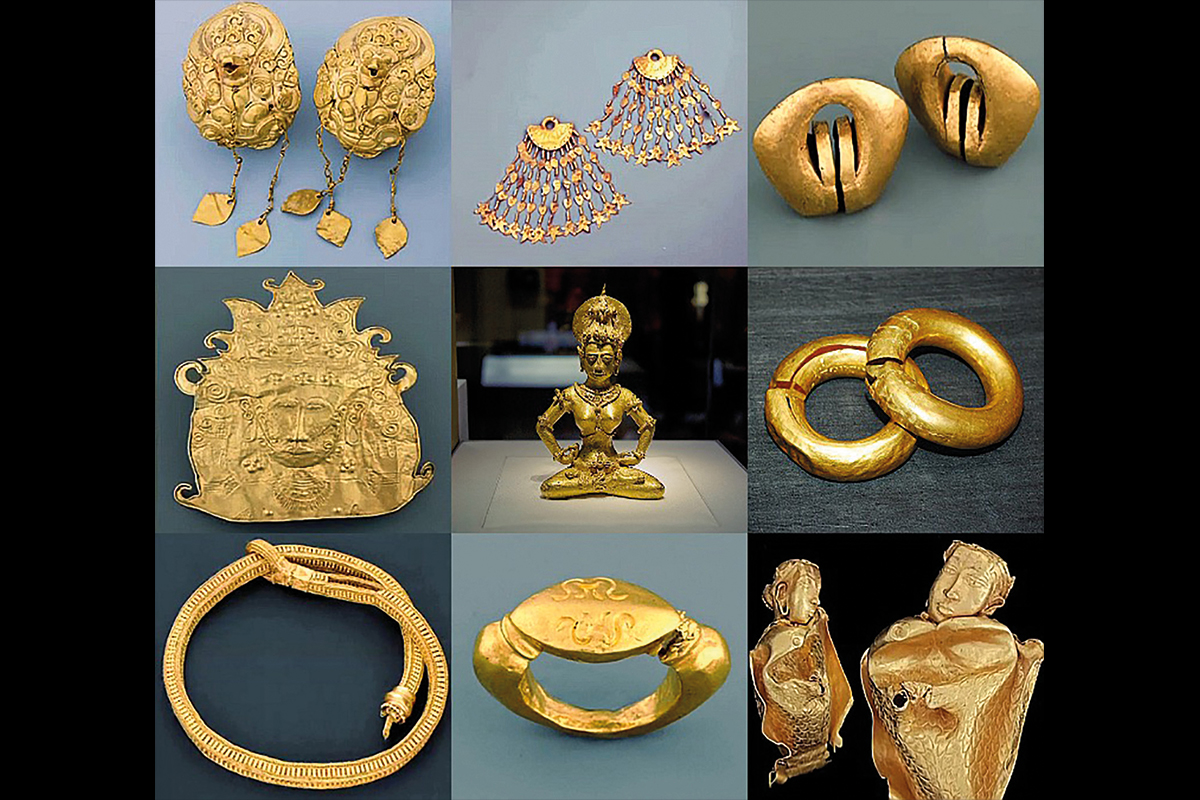
Unearthed in 1981, the Surigao Treasure reveals ancient Filipinos' mastery of goldsmithing. Intricate necklaces and statues, rivaling Indian and Javanese artistry, showcase sophisticated techniques. This episode explores the artistry, spirituality, and legacy of these dazzling artifacts.
An installation in the display cases of the Jewelry Museum to celebrate the 500th anniversary of the expedition around the world of the explorer from Vicenza
In the three-year period in which the fifth centenary of the revolutionary expedition of Antonio Pigafetta and Ferdinando Magellano occurs, the Museo del Gioiello joins the celebrations by illuminating the windows of the spaces dedicated to the Basilica Palladiana with a tribute to the legacy that the famous Vicentine character has left to history compared to one of the aspects that most struck him in the discovery of the civilization and territory of the Philippines: the abundance of gold.
The initiative, called "Antonio Pigafetta narrates: Philippines’ gold", takes shape thanks to a triptych of backlit panels that, starting from May 13th, capture the gaze of citizens, tourists and passers-by with original texts and illustrations of the jewels Philippine antiquities currently preserved at the Ayala Museum in Makati City of Manila.
A special liaison with the Jewelry Museum that combines the arts of a Vicenza protagonist in the world and the cultural richness of the lands of Southeast Asia.
"It is an honor to be able to join the celebrations for Pigafetta500 with an initiative that embraces the city's art, history, culture and tradition - comments Michela Amenduni, Product Marketing & Communication Manager Jewelry & Fashion Division of IEG. The Jewelry Museum is a messenger of Vicenza's contribution to beauty in the world and now testifies to how much Pigafetta was an ambassador of these values already five hundred years ago. "
The quincentennial anniversary of Magellan, Pigafetta and several hundreds of crew members that sailed on a Spanish fleet arriving in the Philippines in 1521.
Perhaps the next major celebration should be the Oldest Street in the Philippines, which is Colon Street, Cebu founded in 1565 which was named after Cristobal Colon (Christopher Columbus). This street is older than any street found in USA. Also, Cebu is considered the oldest city in the Philippines.
In January, Filipinos annually hold a festival in Aklan. The festival is the celebration of peace between the original native Aetas and migrating Malays in the 13th century. They eventually established the first province in the Philippines which is recognized today as the oldest province. The festival is celebrated in a parade like fashion similar to Rio Carnival and Mardi Gras with historical roots and meaning similar to Thanksgiving.
Colon Street(Cebuano:Dalan Colon,Filipino:Kalye Colon,Spanish:Calle Colón;Tagalog pronunciation:[koˈlɔn],Spanish pronunciation:[koˈlon]) is a historical street inCebu City. Located in the city's downtown, Colon Street is often called the oldest[1][2][3]and shortest[4]national road in thePhilippines. It is named after Cristóbal Colón (Christopher Columbus).[5]Built in 1565, the street traces its origins toMiguel Lopez de Legazpi, theSpanishconquistadorwho arrived in the Philippines to establish a colony in the 16th century and eventually developed the street under his leadership.[6][7]
Colon Street, c. 1938
Colon, crowded and a bit run-down now, was the site of fashionable shops, offices, and movie houses. It was once the heart of Cebu City's shopping and business activity. Beginning in the early 1990s, much of this activity has shifted to the more modern, bigger, and diverse commercial and business districts now spread in almost all of the urban areas of Cebu in what was considered residential and leisure settlements.[8]
Colon Street historical marker in Filipino (left) and Cebuano (right)
In 2006, theCebu City Councilproposed a plan to close parts of Colon Street from vehicular traffic and convert it into a tourism zone.[9]However, this proposal received opposition from businessmen and motorists due to concerns about security and parking spaces.[10]
In 2007, the Colon Night Market, which aims to revive Colon as a vibrant commercial hub, was launched. Thenight marketruns multiple times throughout the year, most notably during theFilipino Christmas seasonfrom September to December until theSinulogcelebrations in January of the following year.[11]Since its launch, the night market has run yearly with the exemption of 2020 and 2021 due to theCOVID-19 pandemic.[12]
Historical dispute
While Colon Street has long been recognized as the oldest street in the Philippines, this claim is being challenged. Historians point out that no document or map confirms the construction of Colon Street during the initial period of the Spanish era in the Philippines. The earliest map indicating the presence of Colon Street was dated 1873.[13]
The origin of Colon Street being labeled as the oldest street in the Philippines can be traced back to 1910. During that time, Cebu-based shop American Bazar sold a postcard showing a section of Colon Street with a label "Oldest Street in Cebu".[14]A few years later, photo studio L.G. Joseph printed a postcard of the same street, this time with the label “Oldest Street in the Philippines”. The claim gained further traction in 1933, when the American Express Company added this information to their first ever guidebook of the Philippines.[15]
Although Colon Street in Cebu is considered the oldest street in the Philippines, some historians suggest that Calle Magallanes located also in Cebu takes that claim.
AI Info:
Oldest Streets in USA
Oldest street (general):
Leyden Street in Plymouth, Massachusetts, is the oldest street in America, dating back to the Pilgrims' settlement in 1620.
Oldest continuously inhabited residential street:
Elfreth's Alley in Philadelphia is considered the oldest continuously inhabited residential street, with its origins dating back to 1703.
Oldest street with European settlement:
Aviles Street in St. Augustine, Florida, was likely built in the early 1600s and is considered one of the oldest streets in the U.S. founded by Europeans.
Leyden Street:
Established in 1620 by the Pilgrims in Plymouth, Massachusetts.
Elfreth's Alley:
Considered the oldest continuously inhabited residential street in the United States, with origins dating to 1703 in Philadelphia.
Aviles Street:
Located in St. Augustine, Florida, this street is likely one of the oldest in the country, built in the early 1600s.
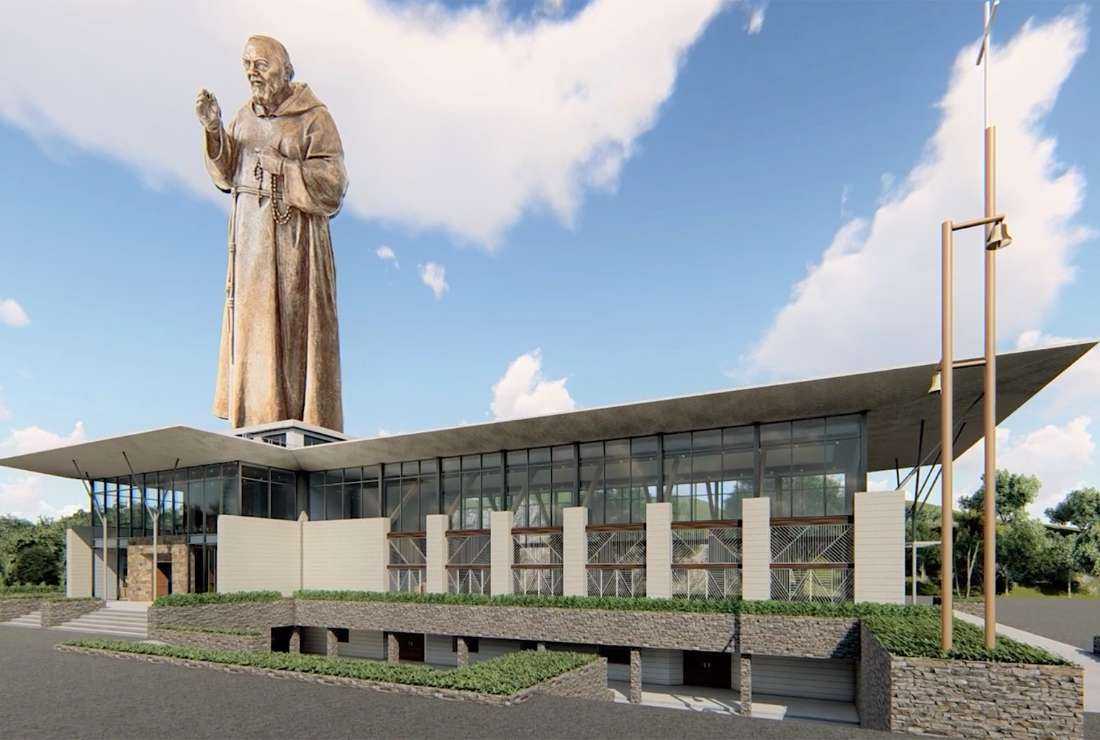
Cebu Archdiocese in the Philippines has started construction of a 100-foot-tall statue of Padre Pio in a sanctuary dedicated to the popular Italian saint.
Archbishop Jose Palma of Cebu led the groundbreaking ceremony for the sanctuary with the contemplative community of Padre Pio, a lay Catholic consecrated group in Cebu, on Sept. 17.
Titled the Santuario di Padre Pio in Pulangbato village, the sanctuary is being built on a hill overlooking the entire city of Cebu, says a report on the Catholic Bishops’ Conference of the Philippines (CBCP) website.
The contemplative group, which promotes devotion to the saint in the country, said that the location choice was symbolic.
“It is symbolic that the sanctuary is the highest church located on the island that welcomed the early missionaries 500 years ago,” Joey Cagasero, a Padre Pio devotee from Cebu, told UCA News.
Christianity in the Philippines arrived in 1521 when Portuguese explorer Ferdinand Magellan and his companions landed on the island in the Central Visayas region.
"We hope that millions if not thousands of devotees of Padre Pio would visit this place"
The natives of Cebu are believed to be the first group of Filipinos baptized.
Magellan planted a cross and gave an image of the Child Jesus (more popularly known as the Santo Nino) to Hara Amihan, the wife of the chieftain of the island.
Both the cross and the image of the Child Jesus were preserved on the island attracting more than a million devotees per year.
The archdiocese said construction of the sanctuary would end next year with the aim to make it a center for healing not just in the region but in the whole country.
“There would be healing Masses and confessions here. That’s our goal. We hope that millions if not thousands of devotees of Padre Pio would visit this place,” Cagasero added.
Cebu archbishop, Jose Palma, said it was his dream for the sanctuary to unite families especially since devotion to Padre Pio should bring every family closer to Christ.
"I hope the center will bring peace to every family”
“The world around us is in crisis, and many forces are working to destroy the Christian Family. There are those who are working to redefine marriage, and in so doing redefine the family according to their whims and desires … I hope the center will bring peace to every family,” Archbishop Palma said during the ground-breaking ceremony, referring to a divorce bill submitted in the Philippine parliament
“May Padre Pio inspire every Filipino to protect every family and to raise every child according to the teachings of the Gospel” the prelate added.
Filipinos pray to Padre Pio for sick family members as well as for safe journeys. Some couples have testified how their petition to have a child was interceded by the Italian saint.
Devotees have testified how their petitions were answered.
“We prayed for our then 8-month-old daughter to get well. She was very sick with pneumonia at that time. The doctors said there was a slim chance of her survival. We prayed to Padre Pio and she made it,” devotee Jason Israel told UCA News.
In 2018, Italian friars who brought the relic heart of Padre Pio to the Philippines were amazed at how thousands had queued to touch it.
“It was a great experience, very beautiful,” friar Giovannie Delle Carri told Church-run Radio Veritas in an interview.
Francesco Forgione, better known as Padre Pio or Saint Pius of Pietrelcina (1887-1968) was a Franciscan Capuchin priest and mystic known for his piety and charity.
He was famous for exhibiting his stigmata, the marks of bodily wounds, scars, and pains corresponding to the crucifixion wounds of Jesus Christ.
Pope John Paul II beatified him in 1999 and canonized him in 2002.
Padre Pio Statue will rival the height of the Statue of Liberty from head to toe, the latter being 111 feet and 1 inch in height.
AI Overview
The Statue of Liberty is 111 feet 1 inch from her heel to the top of her head
PADRE PIO MOUNTAIN OF HEALING I SAN JOSE DEL MONTE BULACAN
Padre Pio Mountain of Healing. PPMH is a private owned property which features a 50ft.
Padre Pio image on the top of a hill, a Way of the Cross and a Chapel. Located at SJDM Bulacan.
location: Brgy. Paradise 3 San Jose del Monte Bulacan San Jose del Monte, Philippines
Video
Padre Pio Statue height is 50 feet in Bulacan. The statue in Cebu that is currently being built will double that height at 100 feet.
AI Overview
The main "Padre Pio Philippines" reference is the National Shrine and Parish of Saint Padre Pio in Santo Tomas, Batangas. This national shrine is a major pilgrimage site for devotees of Saint Padre Pio, an Italian Capuchin friar known for the stigmata and his devotion.
There is also the St. Pio Chapel in Quezon City, another complex dedicated to him.
Salvage work on the 1715 shipwrecks brought over 1,000 coins to the surface this summer.
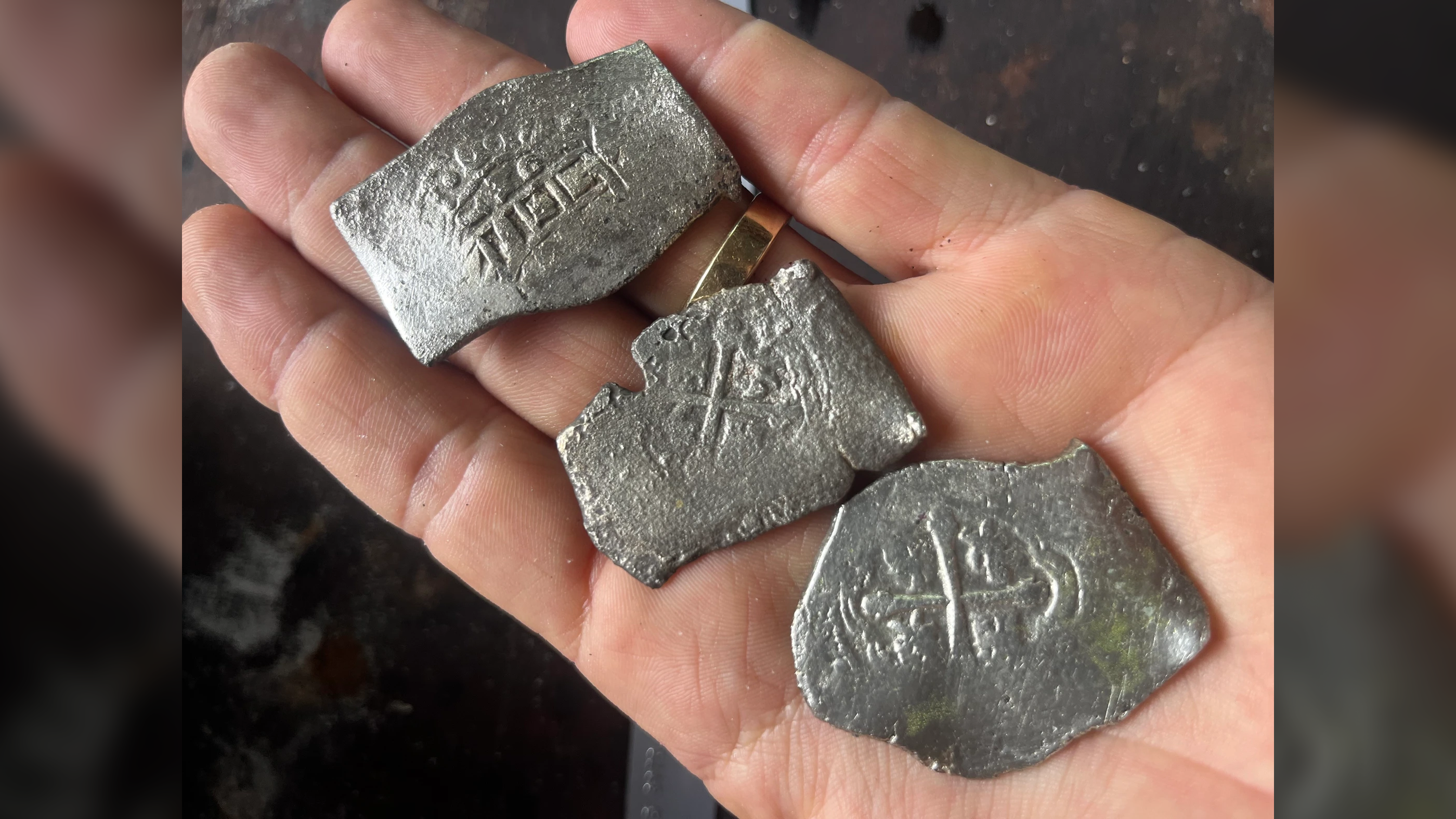
Divers discovered more than 1,000 silver reales from the 1715 "Treasure Fleet" shipwreck this summer.(Image credit: 1715 Fleet - Queens Jewels, LLC)
Divers have recovered over 1,000 coins from a shipwreck off the east coast of Florida. The coins were discovered this summer within the historical "Treasure Fleet" of Spanish ships that sank in July 1715, when hundreds of sailors and over $400 million worth ofgoldand silver disappeared into the ocean.
In astatement, representatives for 1715 Fleet - Queens Jewels, a shipwreck salvage company authorized to dive to the wrecks, wrote that they had recovered more than 1,000 silver reales (also called "pieces of eight") and five gold escudos, along with other rare gold artifacts. Both types of coin were common currency in the Spanish colonies in the Americas.
"Each coin is a piece of history, a tangible link to the people who lived, worked, and sailed during the Golden Age of the Spanish Empire," Sal Guttuso, director of operations for 1715 Fleet - Queens Jewels, said in the statement. "Finding 1,000 of them in a single recovery is both rare and extraordinary."
The coins were most likely minted in the Spanish colonies of Mexico, Peru and Bolivia, according to the statement. Some have mint marks and visible dates, and their excellent condition suggests that they were part of a single collection that spilled and were quickly buried when one of the ships broke apart.
The1715 fleet, also known as the "Plate Fleet," had been loaded with coins and other products from Spanish colonies, and the 12 ships set sail from Cuba on their annual trip back to Spain on July 24. After a few days of sailing, the fleet encountered an intense hurricane off the east coast of Florida. Eleven ships sank, and their remains were scattered over a span of 50 miles (80 kilometers). Some of the treasure was recovered soon after the disaster, but much of it remained under the ocean for centuries.
"Every find helps piece together the human story of the 1715 fleet," Guttuso said. The coins will be conserved and displayed to the public at local museums, according to the statement.
Exploration of the 1715 shipwrecks has produced other impressive finds over the past decade. In 2015, divers found anextremely rare Spanish coincalled a "tricentennial royal" that had been minted for King Philip V of Spain, along with nearly $1 million worth of gold coins and gold chains. But that team, headed by Eric Schmitt of Booty Salvage,failed to report 50 coinsthey found in the shipwreck. Local authorities working with the FBI managed to recover most of the stolen coins in 2024.
Various treasures from the wrecked fleet are likely still hidden under the ocean. The fleet was said to be carrying jewels belonging to Philip V's second wife as part of her dowry, including a 74-carat emerald ring and 14-carat pearl earrings.
UnderFlorida law, removal of artifacts from shipwrecks is illegal unless a permit is secured. 1715 Fleet - Queens Jewels has exclusive rights to dive at the wrecks.
A group of treasure hunters discovered $4.5 millions in gold coins off the coast of Florida. The coins come from the 1715 Fleet shipwreck. CNN affiliate WPTV reports.
Somewhere in the Solomon Islands, a giant gold mine was discovered in 1997. At the time, the locals had no idea how to properly mine gold... and now, about 3,000 people are making a VERY healthy living doing it. From what I have seen today, digging for gold all day in this humidity (and heavy rain) is EXTREMELY difficult, but the best ones are making up to $3,000 a day. For all you math wizards, that's over 1 million dollars a year. Here is the full story of the gold miners in the Solomon Islands. Enjoy!





.jpg)