The First Explorers of Dodo Island: Discovery & Extinction of the Dodo Bird
On this episode of The First Explorers: the story of Mauritius Island & the Dodo Bird’s extinction is one of the wildest, most unhinged stories I’ve ever dug into. I tracked down the 400 year old English translations of the original Dutch explorers of Mauritius Island—to piece together the 100 year collapse of the island & disappearance of, not only the Dodo Bird, but 11 other species...
Here’s what you’ll learn when you read this story:
Stone tool analysis of sites in Southeast Asia provided evidence that the area was a technological leader in seafaring.
Archaeology supports that 40,000 years ago, the people living in Southeast Asia were well-versed in boatbuilding and open-sea fishing.
This research puts Southeast Asia ahead of Europe and Africa in technological process.
In the history of studying the proliferation of humanity across the globe, there has long been one question that has stumped researchers: How did the islands ofSoutheast Asia(ISEA) become so well-inhabited so long ago?
It probably required technological seafaring advancements beyond what was considered likely during thePaleolithic era. But those experts may have a surprising new answer thanks to research that shows the ancient people of the Philippines and ISEA may have mastered seafaring well before anyone else.
The pivotal archaeological evidence comes in the form of stone tools excavated at sites in the Philippines,Indonesia, and Timor-Leste, showing strong evidence that as far back as 40,000 years ago, there was a technological sophistication from these ancient seafarers that rivals much later civilizations. In a studypublishedin theJournal of Archaeological Science,researchers from Ateneo de Manila University challenge the accepted belief that Paleolithic technical progress was centered in Africa and Europe.
Proving seafaring history represents a tricky endeavor, since organic wood and fiber that would have likely been used in constructing Paleolithic seacraft rarely survive in thearchaeological record. These stone tools offer a new way in. The most recent discovery, according to the study, shows traces of plant processing that features the “extraction of fibers necessary for making ropes, nets, and bindings essential for boatbuilding and open-sea fishing.”
Add in the discovery of fishing hooks, gorges, net weights, and the remains of deep-ocean fish such as tuna andsharks, and these archeological sites are a rich exploration of what is obviously a robust seafaring culture.
“The remains of large predatory pelagic fish at these sites indicate the capacity for advanced seafaring and knowledge of the seasonality and migration routes of those fish species,” the study authors wrote. The collection of fish and tool remains “indicates the need for strong and well-crafted cordage for ropes and fishing lines to catch the marine fauna.”
As the archaeological finds point toward a sophisticated method ofdeep-ocean fishing, the study authors believe the ancient seafarers constructed boats from organic materials and held them together with plant-based ropes. That same rope technology was then adapted for the actual fishing.
While widely accepted that the presence of fossils and artifacts across a range of islands provides evidence that early modern humans moved across the open sea, the study’s authors fight against the prevailing theory that the prehistoric migrations were passive sea drifters on bamboo rafts. Rather, they posit that the movement came fromhighly skilled navigatorsequipped with the knowledge and technology to travel to remote locations over deep waters.
“The identification of boat-building materials through direct or indirect evidence is vital in understanding movements across and within island environments,” the authors wrote in the study.
“The presence of such advanced maritime technology in prehistoric ISEA highlights the ingenuity of early Philippine peoples and their neighbors,” the authors said in astatementfrom the university, “whose boat-building knowledge likely made the region a center for technological innovations tens of thousands of years ago and laid the foundations for the maritime traditions that still thrive in the region today.”
The gargantuan heads of Easter Island may have finally tacked on an artist credit — or several, it turns out.
The over 900 statues on Rapa Nui, the indigenous name for the Chilean territory, had long been thought by researchers to be carved by hundreds of workers in a single chiefdom sometime during the 13th century. However, new research has led scientists to believe that each individual statue — called themoai— was most likely carved by competing clans or families.
New research shows that each individual moai statue was most likely carved by competing clans or families.NurPhoto via Getty Images
It is now estimated that each moai, which weighed up to 80 whopping tons, had as few as four to six people working on it.
Archaeologists have determined 30 separate “workshops” where the statues were made by assessing a fresh 3D model featuring the island’s main moai quarry.
3-D model of unfinished moai statues attached to bedrock by “keels” along their backs.Carl Lipo / SWNS
Another piece of evidence pointing to a lack of central management of moai construction is that scientists have determined that the carved statues were transported out of the quarry in several different directions, rather than along one main route.
To create the latest 3-D model that enabled these discoveries (the study was documented in the journal PLOS One), researchers used a drone to take approximately 22,000 photos of the site, which were then integrated into the all-access digital map.
While the new model shows tops and sides of the area that could not be seen on the ground before, thereasonsfor the making of the moai — along with why so much time, funds and manpower were invested in their construction — remain shrouded in mystery.
The Rapa Nui established widespread workshops to build the moai.ArcGIS / SWNS
“The quarry is like the archaeological Disneyland,” said Professor Carl Lipo of Binghamton Universityin a statement. “We see separate workshops that really align to different clan groups that are working intensively in their specific areas.”
“You can really see graphically from the construction that there’s a series of statues being made here, another series of statues here and that they’re lined up next to each other,” Lipo continued.
The recent discovery of the moai’s true builders comes not long after scientists from Binghamton University and the University of Arizona confirmed that the statues were moved by “walking” across Easter Island. They were likely designed to be pulled by some rope in a side-to-side wobbling motion.
“Once you get it moving, it isn’t hard at all — people are pulling with one arm,” Lipo saidin a previous report. “It conserves energy, and it moves really quickly. The hard part is getting it rocking in the first place.”
This screenshot depicts a three-dimensional model of the Rano Raraku quarry.Carl Lipo / SWNS
Lipo and his team even tested out the theory by building a 4.35-ton moai replica that 18 people ‘walked’ forward 100 meters (or 328 feet) in 40 minutes.
All this evidence points to the conclusion that the people of Rapa Nui had an individual clan-based, smooth-sailing system to move their iconic statues.
”(This) really connects all the dots between the number of people it takes to move the statues, the number of places, the scale at which the quarrying is happening and then the scale of the communities,” Lipo said.
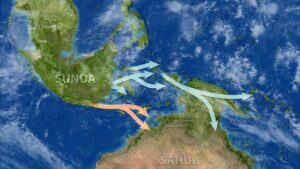
American Association for the Advancement of Science (AAAS)—Humans settled in the ancient landmass, Sahul, that birthed Australia, Tasmania, and New Guinea around 60,000 years ago, according to a new study. The findings challenge a theory held by some researchers, who posit that Sahul’s peopling began 47,000 to 51,000 years ago. Moreover, the work suggests population movements happened via two routes, contrary to what those in the “short chronology” camp theorize. Debate swirls about when humans reached Sahul. The “long chronology” group, which argues that dispersal began 60,000 to 65,000 years ago, relies on evidence from archaeological and radiometric dating. The “short chronology” group favors a later settlement date based on recent Y-chromosomal and mitochondrial DNA data. Now, Francesca Gandiniand colleagues provide mitogenomic evidence that supports the long chronology proposal and identifies two distinct routes that humans took to reach Sahul. They analyzed 2,456 contemporary and already-published mitochondrial genomes from Indigenous populations in Australia, New Guinea, and Oceania. Using a molecular clock approach, they reconstructed an evolutionary tree. Gandini et al.compared the tree’s lineages with mitogenomic data from Southeast Asia. They also accounted for mutation rates, Y-chromosome variation, and genome-wide changes, additionally incorporating climate data and archaeological evidence. Most present-day lineages traced back to humans that took a northern route around 60,000 years ago. The other lineages came from humans who took a southern route. These results also corroborate archaeological and fossil records that indicate the main migration of humans out of Africa likely commenced around 73 to 89 million years ago. Of the study’s implications, the authors write: “We have addressed and refined a Western science narrative that supports the peopling of Sahul in deep time but acknowledges and respects the ontological perspective that many Indigenous people hold: ‘We have always been here.’”
_________________________
Map of Sunda, Sahul, and the Western Pacific, with arrows showing potential migration routes suggested by the mtDNA and Y chromosome distributions.Helen Farr, Erich Fisher
https://tf-cmsv2-smithsonianmag-media.s3.amazonaws.com/filer_public/07/3d/073d2431-3dae-42c1-8ae9-361ac12bcf4e/2021_dugout-canoe-underwater_004.jp g" alt="Underwater view of dugout canoe" width="1026" height="684" />Most of the canoes are still submerged in Lake Mendota, but archaeologists have recovered two of them.Tamara Thomsen
In 2021, archaeologists unearthed the remains of a 1,200-year-old dugout canoefrom a lake in Madison, Wisconsin. A year later, they found a second canoe in the same lake—and this time, the vessel was 3,000 years old. Then they discovered more and more, eventually realizing that they had stumbled upon an entire canoe “parking lot,” writes Todd Richmond for the Associated Press.
In total, researchers have found 16 canoes in Lake Mendota, a 9,781-acre body of water in Madison. Based on the number of canoes and the location of the site, archaeologists suspect the vessels were intentionally stashed there so that anyone could use them for navigating the region’s waterways—sort of like a modern bike-share program.
“It’s a parking spot that’s been used for millennia, over and over,” Tamara Thomsen, a maritime archaeologist with the Wisconsin Historical Society, tells the AP.
https://tf-cmsv2-smithsonianmag-media.s3.amazonaws.com/filer_public/e8/70/e8702363-3801-4244-99c5-858314d11054/2022_whs_mendota_canoe_2_-_074.jpe g" alt="Fragment of a canoe" />A 3,000-year-old dugout canoe was discovered in 2022 and is now being preserved.Dean Witter / Wisconsin Historical Society
For the past few years, Thomsen has been collaborating with the preservation officers with the Ho-Chunk Nation and the Bad River Band of Lake Superior Chippewa, as well as Sissel Schroeder, an anthropologist at the University of Wisconsin, Madison, and the U.S. Department of Agriculture’s Forest Products Laboratory. Together, they’re unraveling the mysteries of the Indigenous canoes, which are some of the oldest surviving specimens of their kind in eastern North America.
<img src="data:;base64," />
“It just feels like [the work is] making a difference,” Thomsen tells the AP. “Each one of these canoes gives us another clue to the story.”
Quick fact: The oldest canoe in eastern North America
Today, Lake Mendota has a maximum depth of 83 feet. However, from roughly 5500 B.C.E. to 1000 B.C.E., researchers think the area experienced a drought. During that time, Lake Mendota was probably only four feet deep at the site where the canoes were found.
Archaeologists have now mapped the locations of all 16 canoes. They’re situated in two distinct groupings, near places where water flowed down to the lake from higher elevations.
“There’s bluffs that are about 35 feet above the lake, and really the only access to get up and down to the lake is through those wash ways,” Thomsen tells Wisconsin Public Radio’s Sarah Lehr. “And we believe that those likely were entry access points for millennia, and that’s why the canoes were left in front of them.”
https://tf-cmsv2-smithsonianmag-media.s3.amazonaws.com/filer_public/87/9b/879bff04-ffb8-41cd-ac2c-a0a9031aa0e7/lake_mendota_canoes_working_map_nov_2025.jp g" alt="Map of lake shore with canoes" />The canoes are situated in two distinct groupings, near places where water flowed down to the lake from higher elevations.Wisconsin Historical Society
<img src="data:;base64," />
Archaeologists also found stone “net sinkers” with several of the vessels, which suggests they were sometimes used for fishing. But they were also probably used to travel between communities and visit spiritual sites.
Radiocarbon dating has revealed that the oldest canoe is around 5,200 years old, while the youngest is 700 years old.
“The canoes give us insight into a sophisticated travel network and interconnected communities who used their incredible skills and knowledge to live and thrive on lands where we still live and thrive today,” says Larry Plucinski, tribal historic preservation officer for the Bad River Band of Lake Superior Chippewa, in astatement. “They reflect a deep relationship with the environment and the ingenuity of our ancestors.”
Researchers have also identified the type of wood used to make each vessel. Half are made of either red or white oak, which is somewhat unexpected, given that red oak has a tendency to absorb water. However, archaeologists think ancient boat builders had a clever workaround for this problem.
<img src="data:;base64," />
When oak trees get stressed—such as from suffering an infection or a wound—they produce internal, balloon-like structures known as tyloses. These structures block the movement of water, thus preventing the spread of pathogens and compartmentalizing injuries. Importantly, for boat builders, tyloses also increase wood’s water and rot resistance, as well as its buoyancy.
It’s possible Indigenous groups were either purposefully selecting damaged trees or wounding them in order to produce tyloses, per the statement.
“If you think about how slow oaks grow, that would mean that someone was managing this forest for generations before the tree was harvested,” Thomsen tells the Wisconsin State Journal’s Barry Adams. “They weren’t just walking through a forest and decided that was the tree they were going to take and cut it down to make a canoe out of it. They were selectively managing trees that were probably near the shoreline.”
https://tf-cmsv2-smithsonianmag-media.s3.amazonaws.com/filer_public/67/0f/670fb54b-caf0-471d-9dda-8a4e9a348b3e/whs_carbon_dates_wood_type_graph.jp g" alt="A chart with colorful dots" />The oldest canoe is 5,200 years old, and the youngest is 700 years old.Wisconsin Historical Society
<img src="data:;base64," />
In addition to oak, researchers also identified ash, elm, cottonwood and basswood, per theWisconsin State Journal.
So far, archaeologists have recovered two of 16 canoes. Since February 2024, experts have been conducting an extensive preservation process, which includes using polyethylene glycol to stabilize the wood. Eventually, the canoes will be taken to Texas A&M University so they can be freeze-dried. One of the vessels is slated to be displayed at the new Wisconsin History Center, which is scheduled to open in 2027.
Meanwhile, archaeologists continue to scour Lake Mendota and other bodies of water for remnants of the past. So far, their searches have not turned up any more dugout canoes. However, Thomsen tells theWisconsin State Journal, that “doesn’t mean they’re not there.” Instead, she says, they’re just “not exposing themselves quite yet.”
“You just have to be patient and keep looking,” she adds.



/ <a class=) https://tf-cmsv2-smithsonianmag-media.s3.amazonaws.com/accounts/headshot/SarahKuta.pn g" alt="Sarah Kuta" />
https://tf-cmsv2-smithsonianmag-media.s3.amazonaws.com/accounts/headshot/SarahKuta.pn g" alt="Sarah Kuta" />
:focal(2464x1643:2465x1644)/ <a class=) https://tf-cmsv2-smithsonianmag-media.s3.amazonaws.com/filer_public/07/3d/073d2431-3dae-42c1-8ae9-361ac12bcf4e/2021_dugout-canoe-underwater_004.jp g" alt="Underwater view of dugout canoe" width="1026" height="684" />
https://tf-cmsv2-smithsonianmag-media.s3.amazonaws.com/filer_public/07/3d/073d2431-3dae-42c1-8ae9-361ac12bcf4e/2021_dugout-canoe-underwater_004.jp g" alt="Underwater view of dugout canoe" width="1026" height="684" />
/ <a class=) https://tf-cmsv2-smithsonianmag-media.s3.amazonaws.com/filer_public/e8/70/e8702363-3801-4244-99c5-858314d11054/2022_whs_mendota_canoe_2_-_074.jpe g" alt="Fragment of a canoe" />
https://tf-cmsv2-smithsonianmag-media.s3.amazonaws.com/filer_public/e8/70/e8702363-3801-4244-99c5-858314d11054/2022_whs_mendota_canoe_2_-_074.jpe g" alt="Fragment of a canoe" />
/ <a class=) https://tf-cmsv2-smithsonianmag-media.s3.amazonaws.com/filer_public/87/9b/879bff04-ffb8-41cd-ac2c-a0a9031aa0e7/lake_mendota_canoes_working_map_nov_2025.jp g" alt="Map of lake shore with canoes" />
https://tf-cmsv2-smithsonianmag-media.s3.amazonaws.com/filer_public/87/9b/879bff04-ffb8-41cd-ac2c-a0a9031aa0e7/lake_mendota_canoes_working_map_nov_2025.jp g" alt="Map of lake shore with canoes" />
/ <a class=) https://tf-cmsv2-smithsonianmag-media.s3.amazonaws.com/filer_public/67/0f/670fb54b-caf0-471d-9dda-8a4e9a348b3e/whs_carbon_dates_wood_type_graph.jp g" alt="A chart with colorful dots" />
https://tf-cmsv2-smithsonianmag-media.s3.amazonaws.com/filer_public/67/0f/670fb54b-caf0-471d-9dda-8a4e9a348b3e/whs_carbon_dates_wood_type_graph.jp g" alt="A chart with colorful dots" />