We were all taught that Ferdinand Magellan sailed west to "discover" the Spice Islands. But that’s a lie. The Portuguese were already there! 🤯 In this episode of Hidden History PH, we uncover the truth about the Moluccas, the Treaty of Tordesillas, and the secret letters from Magellan’s best friend, Francisco Serrão, that sparked the first circumnavigation of the globe. Magellan wasn't an explorer finding a new world. He was a defector using inside information to change the map.
Get ready to embark on a fascinating journey through time! From Wednesday, 4th June to Sunday, 8th June 2025, the Embassy of Italy, in collaboration with the YWCA, invites you to explore 700 Years of Bonds: Unveiling the Journey of Italians in Myanmar. Hosted at the historic YWCA building at 119 Bogalayzay Street, Botahtaung Township, Yangon, this exhibition runs daily from 10 am to 4 pm with free entrance and no registration required. History lovers, this is your chance to dive into the remarkable, yet little-known, story of Italian-Myanmar connections spanning seven centuries.
A Time Machine to the Golden Land
Imagine travelling back in time, from the days of Marco Polo to the modern era, uncovering the threads that tie Italy and Myanmar together. This exhibition brings to life a rich tapestry of cross-cultural exchange, showcasing fascinating stories of explorers, missionaries, and technicians who bridged these two distant worlds. “The idea is really to travel in a time machine, across centuries, and see all the connections that have been established between Italians and Myanmar,” says Mr Nicolò Tassoni Estense, Head of Mission at the Italian Embassy in Yangon. Unlike many historical narratives, this is a positive story, free from the shadows of war or domination, highlighting peaceful collaboration and mutual enrichment.
From Marco Polo to Renaissance Travellers
The journey begins with Marco Polo, the first Italian, and indeed the first European, to set foot in Myanmar, chronicling his adventures in the 13th century. After a long gap, the early 15th century saw intrepid Italians like Nicolo de Conti arrive, documenting their travels and even contributing to early cartography. De Conti’s accounts described Myanmar as part of the “third India,” a land of high civilisation comparable to Europe, where honesty and hard work were rewarded. His records, shared with the Pope’s secretary, became a medieval bestseller, offering a fresh, open-minded perspective on this distant land.
A Special Partnership in the 19th Century
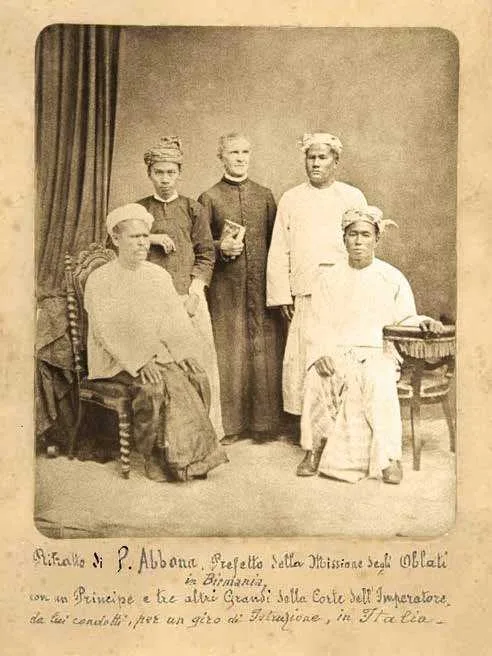
Fast forward to the 19th century, when a small missionary order from Torino, led by the charismatic Father Abbona, forged a unique bond with King Mindon of Myanmar. Father Gabona, a confidant of the king, even negotiated peace during the Second Anglo-Burmese War. This connection paved the way for a broader relationship between the Kingdom of Piedmont and Myanmar, with exchanges of gifts, letters, and plans for a treaty of friendship. In 1871, a unified Italy signed a remarkable treaty with Myanmar, one of equality, allowing Italians and Myanmar people the same rights in each other’s lands, a stark contrast to colonial agreements of the era.
Father Abbona with Burmese Princes, Archives of the Oblates
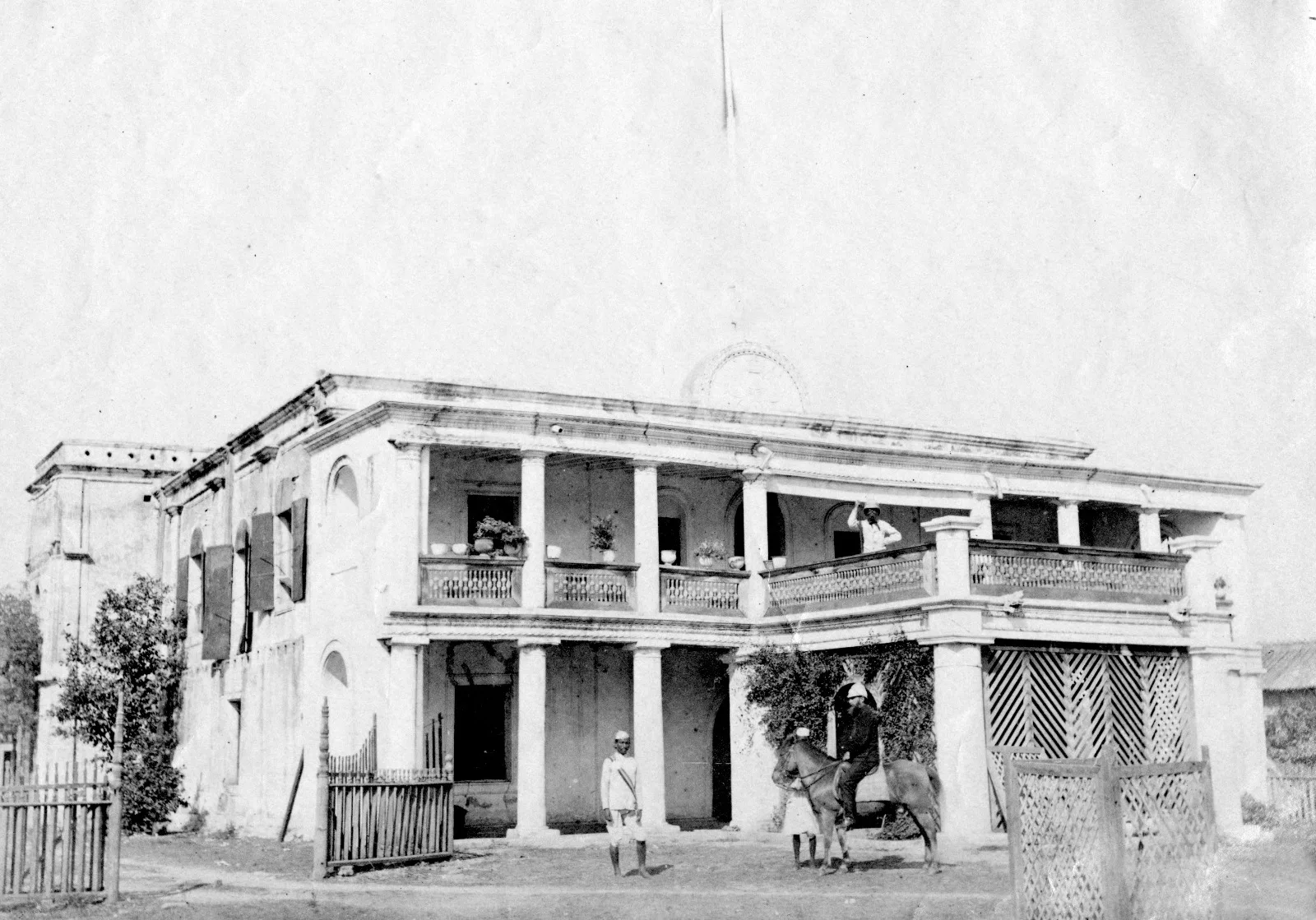
This partnership brought a wave of Italian technicians to Mandalay, supporting King Mindon’s modernisation efforts. From setting up factories and introducing electricity to serving as the king’s doctor, Italians left a lasting mark. Rare photographs, never before displayed, capture this vibrant community, including an 1880s excursion from Mandalay to Mingombel. Though the British annexation in 1885 cut this era short, the legacy of collaboration endures, documented in manuscripts, photo albums, and memories left with the Geographical Society.
The Consulate of Italy i. Mandalay, 1871-1885, Barbieri Collection, Museo PIME, Milan
Missionaries and Cultural Bridges
The story continues with the PIME missionaries, who ventured into the Shan and Kayah regions in the late 19th and early 20th centuries. Working in remote, animist villages, they compiled dictionaries of local languages, preserving oral traditions in written form.
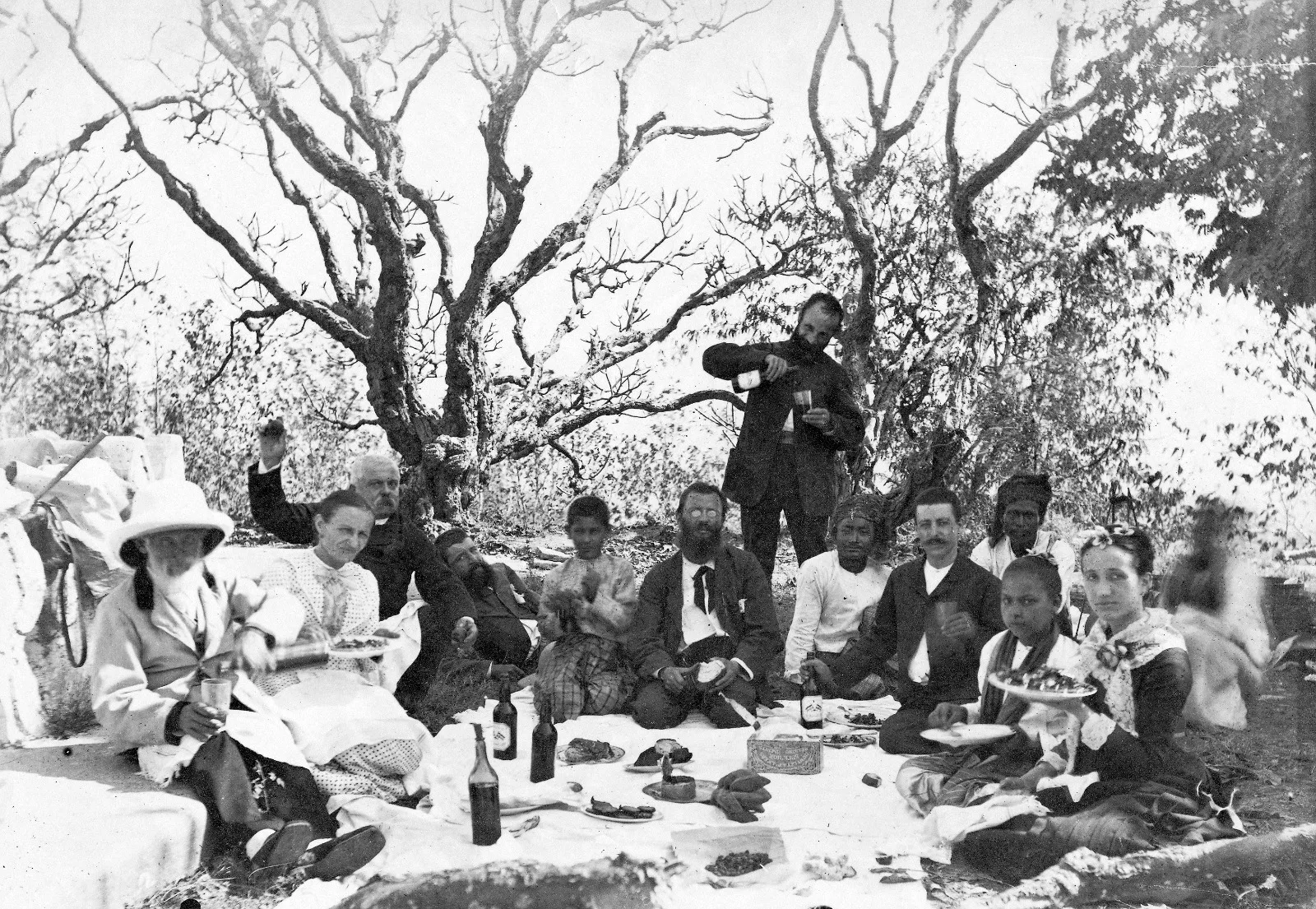
A picnic of the Italian community in Mandalay, around 1880, Barbieri collection, Museo PIME, Milan
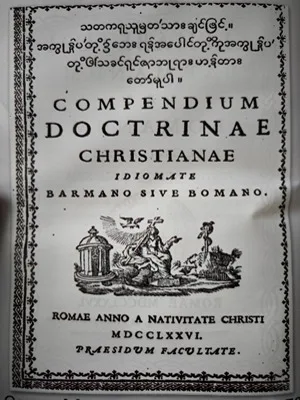
The first Burmese Bible, printed in Rome in 1776, marked a milestone as Myanmar’s first printed book, a testament to the missionaries’ role in cultural exchange. Figures like Father Vismara, a beloved 91-year-old priest known for his humour and resilience, left a lasting impression, raising generations of Myanmar Catholic priests in the East.
First book in Burmese characters, printed in 1776 in the Vatican press
The Legacy of Lokanatha
One of the most captivating tales is that of Salvatore Cioffi, born in Naples in 1897, who became the revered monk Lokanatha. A chemist by training, he discovered the Dhammapada, embraced Buddhism, and settled in Myanmar. Known for his extraordinary discipline – sleeping in the lotus position for life – and charisma, he drew thousands of followers, including Aung San. After World War II, Lokanatha spread Buddhism to Europe and America, earning a state funeral at Shwedagon Pagoda in 1966. His story embodies the deep cultural integration between Italy and Myanmar.
A Positive Legacy
This exhibition celebrates a 700-year saga of cross-fertilisation, where identities were shaped by mutual respect and collaboration. “There is no negative page of war, domination,” Mr Nicolò emphasises, offering a refreshing contrast to the colonial trauma often associated with Europe-Myanmar relations. From early travellers to modern times, Italians documented customs, mapped regions, and contributed to a better understanding of Burmese civilisation.
Event Details
What: 700 Years of Bonds: Unveiling the Journey of Italians in Myanmar When: Wednesday, 4th June to Sunday, 8th June 2025, 10 am – 4 pm Where: YWCA, 119 Bogalayzay Street, Botahtaung Township, Yangon Cost: Free entrance, no registration needed Bonus: A seminar and activities are planned for Saturday, 7th June, to deepen your experience.
Don’t miss this chance to explore unseen photos, rare documents, and a positive narrative of cultural exchange. Join to celebrate a legacy that transcends time, proving that connections between Myanmar and Italy are not just history – they’re a living story of hope and solidarity.
One of the most impressive archeological sites in Asia, Bagan is a key center for historic Buddhist culture.
NASA Earth Observatory
Feb 23, 2020
Article
February 6, 2020
When explorer Marco Polo passed through modern-day Myanmar (Burma) about 700 years ago, one city caught his attention: Bagan. Known as Pagan at the time, it was the capital of the Pagan Kingdom. This first Burmese empire lasted from the 9th to 13th centuries and had heavy Buddhist influences. Around 10,000 temples and religious structures were built in the capital in that era, and Polo was captivated by the numerous spires that dotted the landscape, saying the towers made the city “one of the finest sights in the world.”
In the middle of the 13th century, the Pagan Kingdom collapsed due to invasions by the Mongols. Many of the city’s temples and pagodas crumbled from the repeated attacks as well as natural disasters (mostly earthquakes). Yet more than 3,000 historic buildings and ruins still stand today, making Bagan one of the most impressive archeological sites in Asia.
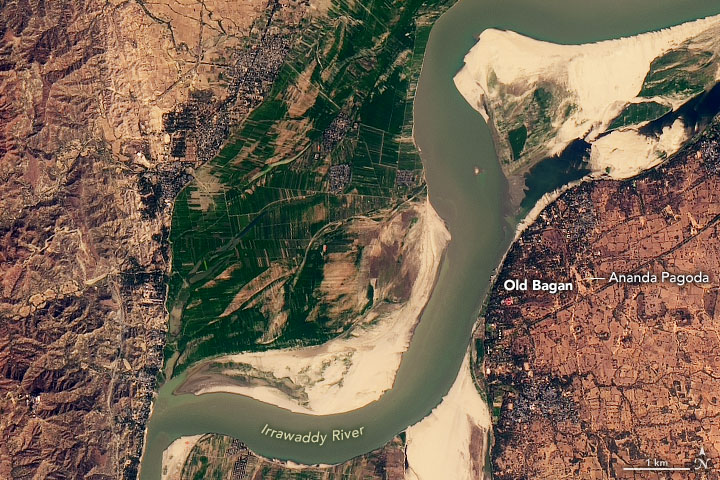
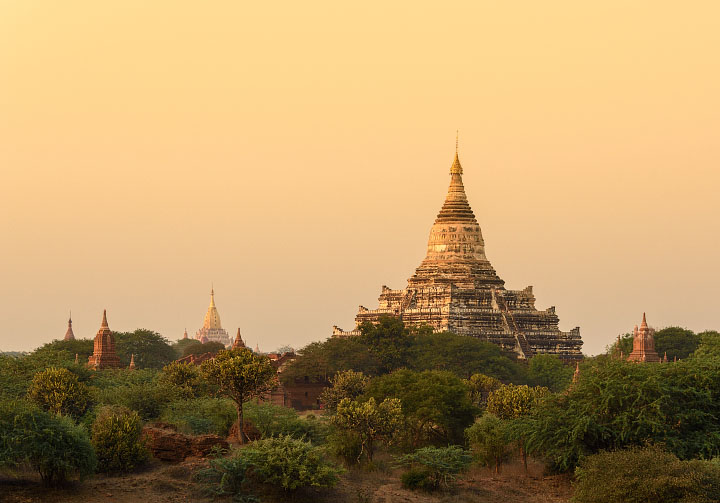
The satellite images above show the Bagan Archeological Zone on February 6, 2020. The zone includes four main settlements: Old Bagan, New Bagan, Myinkaba, and Nyaung U. The ancient temples, pagodas, and other religious structures are mainly located within 26 square kilometers (16 square miles) of Old Bagan. The natural-color images were acquired by the Operational Land Imager (OLI) on the Landsat 8 satellite. The photograph below shows temples rising above the landscape in Old Bagan.
One of the most well-known and beautiful structures is the Ananda Pagoda, sometimes referred to as the “Westminster Abbey of Burma.” Built around 1105, it is one of the largest and best preserved of the Bagan temples. Ananda Pagoda is the centerpiece of one of the city’s biggest festivals, which celebrates the traditional lives of farmers with decorated bullock carts.
The Bagan Archeological Zone lies next to the Irrawaddy River (also known as the Ayeyarwady), the main waterway running through Myanmar (Burma). In the 13th century, the Pagan Kingdom gained control of the river and transportation on it, which helped them rule over lands farther away. Today, the river is an important avenue for commercial transportation and helps provide fertile area for farming. The river is also home to the endangered Irrawaddy dolphins.
Today more than 500,000 people visit Bagan each year. In 2019, the region was named a UNESCO World Heritage Site in order to promote preservation of the historic Buddhist temples and ruins.