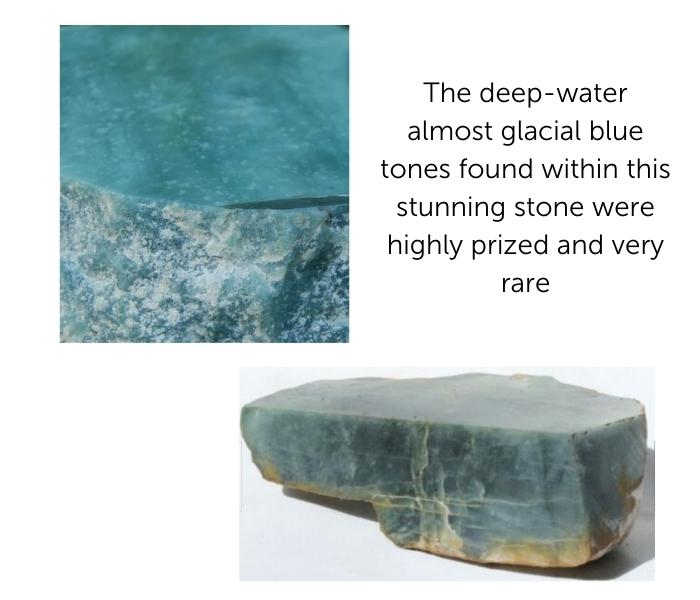
Olmec blue jade is a rare, highly valued, and translucent blue-green jadeite primarily sourced from Guatemala’s Río El Tamborregion. Prized by the Olmec civilization (1500–400 BCE) for its unique color, it symbolized water, sky, and regeneration. It remains a sought-after gem for high-end jewelry and carving today.
Key Aspects of Olmec Blue Jade:
Significance: The Olmec used blue jade to represent water, the Underworld, and the blue skin of snakes before shedding, making it essential for ritual items.
Color Range: While known as "blue," the stone ranges from pale blue to deep oceanic, translucent blue-green.
Source: The ancient, high-quality material is mined in the Motagua River Valley in Guatemala, a source re-discovered in 2002.
Usage: Ancient artisans created highly polished, symbolic, and religious artifacts. Modern, authentic pieces are still used in carvings and jewelry, sometimes seen on platforms like Jade Maya or Etsy.
Learn about this once forgotten, seemingly lost in time, beautiful blue toned Jadeite
Olmec Blue Jadeiteis an incredibly rare and elusive stone to mine, found in North and Central America with the best examples of this stunning blue gemstone being found in the basin of the Upper Río El Tambor in Guatemala. In Ancient times this location was known as Mesoamerica and was inhabited for thousands of years by groups such as the Olmec, Zapotec, Maya, Toltec, and Aztec people.
Into the blue...
Olmec Blue Jadeite is famed for its translucent deep watery blue colour and owes this to the presence of iron and titanium in its chemical composition. The more readily found green Jade’s color is due to the amount of iron, sodium, Chromium and aluminum with the varying quantities causing the depth and tone of colour to fluctuate.
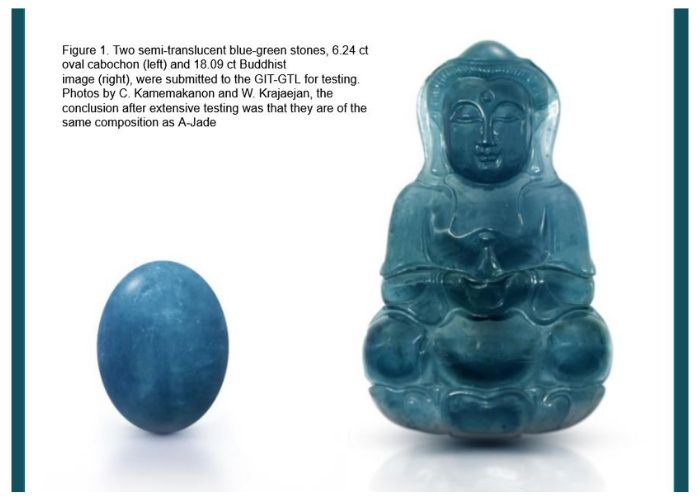
The Gem and Jewelry Institute of Thailand (GIT-GTL) say Jadeite-jade is one of the most sought-after gemstones that is rich in cultural and historical background. Jadeite is characterized by its transparent to opaque, close-packed fibrous aggregate structure, resulting in its high toughness suitable for carving. The stone can be found in various colors ranging from white, green, lavender (purple or violet), brown, blue and black. Among those, the green and lavender are the most famous hues, whilethe blue is considered the rarest variety of this jade.
This stunning blue version of the stone was highly prized by the Olmec people and was used for medicinal purposes as well as for jewellery, ornaments, and religious artifacts. In fact due to the range of blue and green tones found in the Jadeite the Mesoamericans often associated it with the Sky, Water, New growth in the form of Maize Shoots and the concept of life, abundance, and regeneration. They were also known to leave a small piece of Jadeite in the mouth of a deceased loved one due to is association with life and renewal.
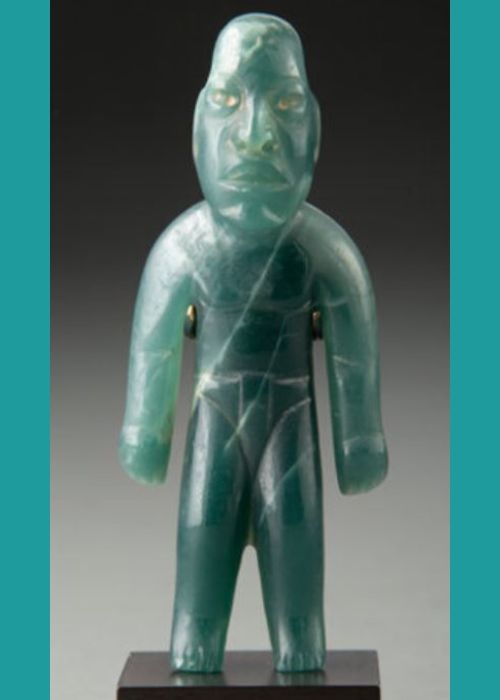
This image shows an Olmec Blue Jadeite Standing Figure - Imaged by Heritage Auctions HA.com
The Olmec Blue Jadeite Mines - lost and found
Jadeite was the most valuable material for the ancient Olmecs, Maya, Zapotecs, and other Mesoamerican cultures. In the 16th century whole of Mesoamerica was conquered by the Spanish, whose love of gold and well known gemstones such as Emerald far surpassed any desire to treasure these unusually coloured stones. The Mayan mine guards kept their location secret but as their beloved Jade was inconsequential to the Spaniards, they soon became forgotten and lost when the guards died out. It is also thought that volcanic activity in the area caused huge swathes of the country and those who lived in it to perish and become buried.
It wasn't until 450 years later in 1974, when pioneers Jay and Mary Lou Ridinger rediscovered and re-established the Jade industry in Guatemala. Later research conducted by the Mesoamerican Jade Project of Harvard's Peabody Museum of Archaeology & Ethnology between 1977 and 2000 led to the identification of the long lost 'Olmec Blue' mines, a discovery published by Mesoamerican Jade project Field Director Russell Seitz and his colleagues from the American Museum of Natural History in Antiquity in December 2001. Then only as recently as 2002 led by local prospector, Carlos Gonzalez did they find the ancient mines with huge blocks of high-quality Olmec blue jadeite in the upper reaches of Río El Tambor
How can Blue Jadeite help me?
How can I own a piece of Olmec Blue Jadeite?
You can shop on our website for Olmec Blue Jadeite pieces, but stock of this incredible gemstone is limited so don't miss this amazing opportunity!
The Costa Rican *Jade Axe God Celts* are remarkable artifacts from pre-Columbian Central America, particularly associated with the Diquís culture of southwestern Costa Rica. These objects, crafted from jade, a rare and highly valued material in ancient Mesoamerica, date back to around 500-1500 CE. What are Jade Axe God Celts?
*Celts* are a type of axe-shaped stone tool used by ancient civilizations, typically in ceremonial or symbolic contexts rather than for practical purposes.
The term *Axe God* refers to the stylized human or deity figures carved into these jade celts. These figures often represent gods or ancestral beings, believed to have spiritual significance and protective qualities.
Design and Iconography: The figures depicted on the jade celts usually combine human and supernatural traits, characterized by:
**Axe-like bodies**: Their overall shape resembles a blade or axe, symbolizing power and strength.
**Deity figures**: The figures are often standing or seated, with abstract and geometric details. They might show facial features, body adornments, or headdresses, which indicate divine or shamanistic aspects.
**Symmetry**: The carvings display a sense of balance and precision, with the figure’s form fitting perfectly into the axe shape, blending form and function.
Purpose and Cultural Significance: These jade celts were not functional tools but served as:
**Status symbols**: Jade was rare in Costa Rica, making these celts prestigious items associated with elite individuals, rulers, or shamans.
**Ritual objects**: The carvings likely played a role in religious ceremonies, symbolizing divine protection, fertility, or the favor of gods. The Axe God motif may have represented the connection between rulers and the divine, with the power to mediate between the human and spiritual realms.
**Burial offerings**: Many jade celts have been found in tombs, suggesting they were buried with important individuals to provide spiritual guidance or protection in the afterlife.
Craftsmanship: Creating these jade artifacts required advanced stone-carving techniques. Jade is incredibly hard and dense, so artisans used tools made from even harder materials, like quartz or other stones, to shape and polish the jade into intricate designs. Context in Costa Rican Archaeology: Costa Rica was part of a larger cultural area known as the **Intermediate Area**, which connected the Mesoamerican and Andean civilizations. While jade celts are found across Central America, Costa Rican examples stand out for their artistic quality and their integration into local cultural traditions. These artifacts reflect the region's complex social and religious systems, as well as the influence of long-distance trade routes that brought jade from regions such as Guatemala. The Jade Axe God Celts thus provide a window into the spiritual life, artistry, and social structure of ancient Costa Rican cultures, making them a key element of pre-Columbian heritage.
Video
The Museo del Jade (Jade Museum) in San José, Costa Rica, houses the world's largest collection of pre-Columbian American jade. Founded in 1977, it features five floors of artifacts showcasing jade carved into figures, jewelry, and tools between 500 B.C. and 700 A.D.. The museum is open daily (8 AM–5 PM) near the Plaza de la Democracia.
Key Highlights & Information:
Collection: Includes nearly 7,000 pieces, featuring green and blue-green jade carvings of birds, shamans, and frogs.
Historical Significance: Pre-Columbian Costa Ricans often traded for this jade, with much of it sourced from the Motagua River Valley in Guatemala.
Visitor Details:
A typical visit takes 2-3 hours. The museum is highly ranked (#4 in San José) and features interactive displays.
Location: Located in San José, in front of the Plaza de la Democracia.
Pre-Columbian Jade in Costa Rica: Mesoamerican Ties
My last column focused on ancient house and tomb forms, agriculture and the first chiefdoms in the several centuries before and after Christ, and how they seem to have been influenced by Mesoamerica, the lower half of Mexico, Guatemala, El Salvador and the western tip of Honduras (TT, March 27).
This time let’s focus on what else was going on in that time period in Costa Rica, and why that early northern influence gave a Mesoamerican aspect to those peoples who occupied the country some 2000 and more years ago: lapidary work in jade or similar hard, greenish stones.
It has long been one of archaeology’s enigmas: How could it be that more jade pendants, many of the highest quality, have been found in Costa Rica than in all of Mesoamerica, where the jade-carving tradition began and flourished for the first time, in the Olmec civilization of Mexico’s Gulf Coast?
The reverence and esteem for jade artifacts began in Mesoamerica, even before the first Olmec civilization. There, it took the form of pendants, tiny free-form sculptures and even masks and small vessels before 1200 B.C. The importance and sacredness of jade artifacts cannot be overestimated – it was by far the most prestigious material controlled by the high-ranking social strata, with strong religious overtones.
Among Mesoamerican cultures, especially the Maya, jade symbolized water, fertility and young green maize plants; it was seen as the holy symbol of salvation in the real world, and only the highest-ranking personages owned and displayed the best jade pendants.
This same conception of jade was held in Costa Rica, perhaps even more strongly, in the centuries around the time of Christ. Whereas Maya jades often portrayed ceremonial or mythic scenes, carved in low relief, Costa Rican jades, like Olmec examples, stressed iconic images of different birds or human shamans, most often situated above a symbolic polished axe, the tool of primary clearing of agricultural plots, to fell trees and split logs used as a wedge.
The continuity between Mesoamerican and Costa Rica jade symbolism is notable; agriculture and the control of its products was the basic underlying motif.
Most pre-Columbian jade carving in Costa Rica took place in the country’s north-west quadrant – Guanacaste-Nicoya – and also the central and northeast Caribbean watershed. The central highlands were also included, but to a somewhat lesser degree. It is interesting to note that the northwest Costa Rican jades, between about 400 to 500 B.C. and A.D. 400, were primarily rather stiff and imposing axe-gods, mostly avian and human motifs.
Some of the human effigies even seem to show curlicues that, in Mesoamerica, were always interpreted as speech scrolls – that is, the shaman or chief was depicted making a pronouncement. Further, the imported Olmec and Maya jades found in Costa Rica (mostly by looters, unfortunately) have tended to be found in that part of the country.
In the Caribbean watershed, jade carving styles and symbolism were different, frequently emphasizing openwork complex carvings with double or triple aspect symbolism. But they also produced the typical axe-god form, in many different stones.
What is Social Jade?
For several decades now, archaeologists have realized that much of the lapidary corpus known from Costa Rica around the time of Christ is not actual jade (mineralogically, only jadeite and nephrite are true jade).
In fact, the only fairly close, scientifically confirmed source of all colors of true jadeite is, so far, the Motagua River valley of Guatemala.
Other similar hard green stones were used with great frequency in Costa Rica – serpentine, chalcedony, opal, quartzite and others, even including black slate, which in the tombs oxidizes to a light green and is much softer than jade.
The greenstone symbolism was key. Even though lesser stones constitute much of the Costa Rican lapidary complex, the best-carved, largest and most sophisticated examples have been shown by mineralogical analysis to be true jadeite, implying a thriving trade in crude jade or axe-shaped blanks from Mesoamerica to Costa Rica.
A still-to-be-solved enigma is the geological presence in Costa Rica’s far northwest corner – the Santa Elena Peninsula – of a suite of naturally occurring minerals that, in other parts of the world, are associated with true jadeite. At present, I am one of those archaeologists who believes (like many before me) that there was a source of jadeite in that part of Costa Rica, today either exhausted or beneath sea level. The sheer quantity of superior-quality Costa Rican jades makes this hypothesis worthy of continued investigation.
In this episode of Desert Lore, I take you to visit the ancient ruins of Tuzigoot in Arizona. Tuzigoot is a unique pueblo built by the ancient Sinagua people. It is built on a limestone ridge in the flood plane of the Verde River. Looking very much like a medieval castle, this unique site also boasts a great museum displaying many artifacts. In this video I first tour the museum and then hike through the ruins themselves, teaching all along the way.
Templar Gemstones often refer to historical, sometimes mystical, artifacts linked to the Knights Templar, including ancient Abraxas stones used as amulets and, in modern interpretations, andalusite ("seeing stone"). Legend connects them to hidden treasures and encoded, sacred stones. Today, the term also refers to masonic jewels.
Abraxas Stones: These are antique gemstones frequently engraved with the word "Abraxas" or other symbols, which the Templars reportedly used as protective amulets or seals.
Andalusite ("Seeing Stone"): Modern practitioners associate this stone with the Templars, believing it serves as a "seeing stone" that helps analyze different sides of a situation or person, providing balance and mental clarity.
Templar Stones: These refer to sacred, often carved slabs found in places like Scotland, associated with the order's history.
Jewels and Brooches: Modern interpretations often involve red sapphire or crystals set in medals and breast jewels representing the order.
The Knights Templar are most traditionally associated with chiastolite (a variety of andalusite), often called the "cross-stone" due to the natural black cruciform pattern found in its center. Medieval legends suggested these stones were soaked with drops of Christ’s blood and could protect the wearer from battle injuries.
While the historical Order lived under a vow of poverty, they amassed vast wealth and were known to use ancient engraved gemstones as seals. Modern Masonic and Templar-inspired jewelry continues this tradition by using specific gemstone colors to represent different degrees or values.
Notable Gemstones & Symbolism
Chiastolite (Andalusite): Historically revered as a sacred "cross-stone" because its natural inclusions form a cross. It was widely used in Templar rings and amulets for protection.
Red Gemstones (Ruby, Garnet, Red Sapphire): Symbolize the Croix Pattée (the red cross), representing martyrdom and the blood shed for a holy cause. In modern Masonic orders, red stones often signify the Royal Arch Masonry or York Rite.
Abraxas Stones: Ancient antique gemstones engraved with the figure of Abraxas, used by the Templars as talismans or seals for their expansive treasuries.
Purple Gemstones (Amethyst): Frequently used in modern "Past Grand Commander" jewels and pocket decorations to denote high-ranking officers or specific Masonic branches like the Scottish Rite.
Black Stones (Onyx, Obsidian): Used in contemporary jewelry to represent grounding and protection, often paired with the white mantle symbolism of the Order.
This stone was considered sacred by members of the most mysterious medieval order - the Knights Templar. It comes as no surprise since the rock may change its colour in a matter of a few minutes.
Andalusite's name derives from Andalusia (Spanish: Andalucía), the southernmost part of Spain. Yet humanity had been aware of the mineral's existence long before it was unveiled officially. Back then it was more known as "cross-stone", which is, in fact, a non-transparent variety of andalusite.
The stone became most widespread in the Middle Ages, particularly among Templar Knights who used it to make rings and amulets. They believed the mineral was soaked with drops of Christ's blood and could protect those having it on them from battle injuries. The explanation is that the earlier mentioned variety, named chiastolite, commonly contains inclusions forming a cruciform pattern when shown in cross-section. The resulting image thereby heavily resembled the official symbol of the Templars.
The Order of Malta's representatives attributed magical features to andalusite, whereas alchemists were keen on its unusual outward appearance. There is a legend that Nostradamus, a worldwide known French seer, favoured the mineral, too. According to the legend, he had numerous jewel items with andalusite, including several rings, a pendant, and beads.
A notable characteristic of andalusite is the ability to change colour. Unlike alexandrite, which can do likewise, andalusite does not require a change in light to become of a different shade but a slope angle to be altered. Because of this peculiarity, the mineral was sometimes referred to as "poor man's alexandrite".
The mineral is widely spread across the world. However, there are few deposits of gem-quality andalusite. Stone samples vary in colour a lot: from warm shades of yellow and golden-yellow to grey and grey-brown. Colourless specimens are quite rare nonetheless. In jewellery, highly transparent samples are of more value.
Despite looking fancy, andalusite has more uses outside of the jewellery industry. It is commonly used as a refractory due to being able to withstand temperatures of up to 1850 degrees Celsius. Finally, the mineral is applied in the production of, for instance, spark plugs.
Chiastolite, also known as the "cross stone", is considered a variety of Andalusite. The dark cross on the Chiastolite resembles the Templar cross.
Andalusite Explained - Mineral Manual
Discover the unique mineral Andalusite and its fascinating colour-changing properties 💎
In this video, we explore how to identify Andalusite, its distinctive crystal shapes, and its incredible pleochroism—showing different colours from different angles. You’ll also learn where it forms, its industrial uses, and why certain varieties like chiastolite have been historically significant.
Perfect for anyone interested in minerals, geology, crystal identification, and gemstones, this video gives you a clear and engaging overview of this remarkable mineral.
Video
Chiastolite, a variety of Andalusite
The presence of these crosses caused the mineral to be used as a gem. Chiastolite specimens were distributed throughout Europe from the 16th century, as an amulet or souvenir provided by the pilgrims returning from Santiago de Compostela (Saint James of Compostella), in Spain. When chiastolite appears in the old books of mineralogy, it is cited with the name of lapis crucifer or lapis cruciatur, cross stone. The first figure of a chiastolite appears in Laet's book De Gemmis et Lapidibus, published in 1648.[2] The chiastolite specimens sold to the pilgrims came from Asturias, where it is very abundant, in large specimens, in the area of Boal.[3]
Chiastolite (pronounced ky-AS-tuh-lyte) is a cream to brown andalusite gemstone with a black geometric cross pattern. Many call chiastolite the “cross stone.”
Is chiastolite the same as andalusite? Sort of. Andalusite is its own mineral, but it also has two varieties: viridine and chiastolite. So, every chiastolite is andalusite, but not all andalusite stones are chiastolite.
Is chiastolite rare? Yes, very rare. Gem-quality andalusite stones are already rare, and chiastolite is an even rarer variety.
Abraxas stones are ancient Gnostic amulets, often featuring a composite creature (rooster-headed, snake-legged), that appeared on 13th-century Knights Templar seals, specifically in a 1214 French charter. These symbols, interpreted by Gnostics as a supreme deity, likely entered Templar possession through their Eastern,, or "Outremer," treasuries, rather than indicating active Gnostic heresy.
Key Aspects of Abraxas and the Templars:
Symbolic Meaning: Abraxas represents a deity combining opposites (good/evil, light/dark), often linked to the 365 days of the year.
Templar Usage: The figure appeared on the seal of a Templar Grand Master, leading to later accusations of idolatry or Devil worship, similar to the Baphomet legend.
Origin: The stones were popular 2nd-century amulets representing a Gnostic solar deity associated with power and wisdom.
Appearance: Typically, the figure has a rooster's head, a man's body, and snakes or scorpions for legs, carrying a whip and shield.
Controversy: The presence of these, along with alleged manuscripts, on Templar artifacts fueled accusations of esoteric, heretical beliefs, rather than mainstream medieval Christianity.
Would you like to explore how these symbols relate to other hidden Templar symbols, such as the Baphomet, or delve into the specific charges made against the Order?
Seal of a Templar Grand Master in a French charter dated 1214, depicting Abraxas
The word Abraxas (or Abrasax or Abracax) was engraved on certain antique stones, called Abraxas stones, which were used as amulets or charms by Gnostic sects. The image most associated with Abraxas is that of a composite creature with the head of a rooster, the body of a man, and legs made of serpents or scorpions; carrying a whip and shield. The Gnostics identified Abraxas with Yahweh (under the Greek form "IAO"). Amulets and seals bearing the figure of Abraxas were popular in the 2nd century, and these stones survived in the treasuries of the middle ages.
Abraxas appears on the seal of a Templar Grand Master in a French charter dated 1214. The Templars' use of Abraxas as a seal was most likely a result of their expansive treasuries containing a number of ancient gemstones.[4]
The Knights Templar, a wealthy medieval military order, used specific stones for protection and symbolism, notably andalusite (chiastolite), often called "cross-stone" for its natural, dark, cross-shaped inclusions. They wore these stones in rings and amulets, believing they were soaked with Christ's blood and afforded protection in battle.
Key Templar Gemstone and Symbolism History
Andalusite/Chiastolite: A non-transparent variety of andalusite that shows a cruciform pattern in cross-section. Templars valued this "cross-stone" as an amulet.
Symbolic Meaning: The stone was seen as a divine protector and a reflection of the Templar cross, strengthening its popularity among knights.
The Maltese Cross: While more widely associated with the Knights Hospitaller, this cross variant is heavily linked to later Templar jewelry, with its four arms and eight points representing knightly virtues.
Treasure Legends: The massive wealth of the Templars, often depicted as a mix of gold, gems, and religious artifacts, fueled myths that they hidden treasures.
Hidden Symbols: Templar sites and artifacts often hide symbolic messages, such as carvings found in the Byzantine church at Meteora.
Artifacts: A "boat stone" found in North America is suggested to have 14th-century Templar origins, featuring a crossbow arrow and markings that act as a map.
Visit Meteora +5
Some stones, such as the so-called "Templar Stones" in Scotland, were once believed to be linked to the order but are now known to be of different origins.
Crusader and Templar-themed jewelry frequently features red onyx, green onyx, or carnelian gemstones set into Jerusalem or Templar cross designs, often in gold or silver. These modern designs evoke the medieval order's symbolism and the red cross worn by knights during the Crusades.
Common Gemstones: Red onyx (representing the blood of Christ/sacrifice), Green onyx, and Carnelian.
Red Onyx
Green Onyx
Red Onyx
Red Carnelian
Designs: Often paired with the Jerusalem Cross or the Pattee Cross (Templar Cross).
Metal Options: White gold, yellow gold, rose gold, and sterling silver are common in modern interpretations.
Symbolism: Modern pieces, such as those shown at Gold Jewelry USA, often use red onyx to represent the garnet-red color associated with Templar bravery and sacrifice.
Historical Context While medieval Templars were sworn to poverty and avoided excessive luxury, they managed vast wealth. Historical artifacts (shown at Cannon Beach Treasure Company) often include silver deniers and Crusader coins, rather than ornate, large gemstone rings.



Visit Meteora +5