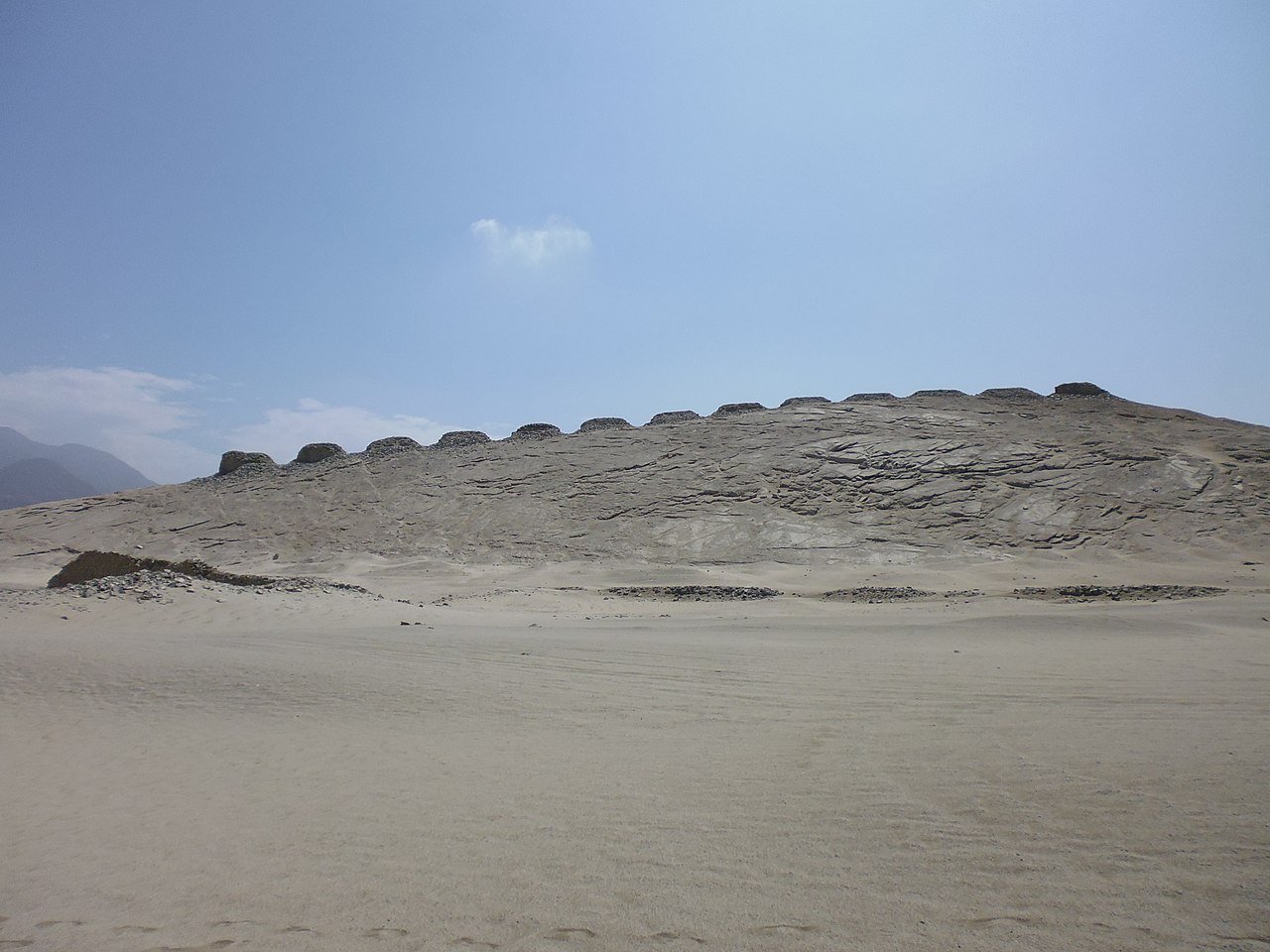
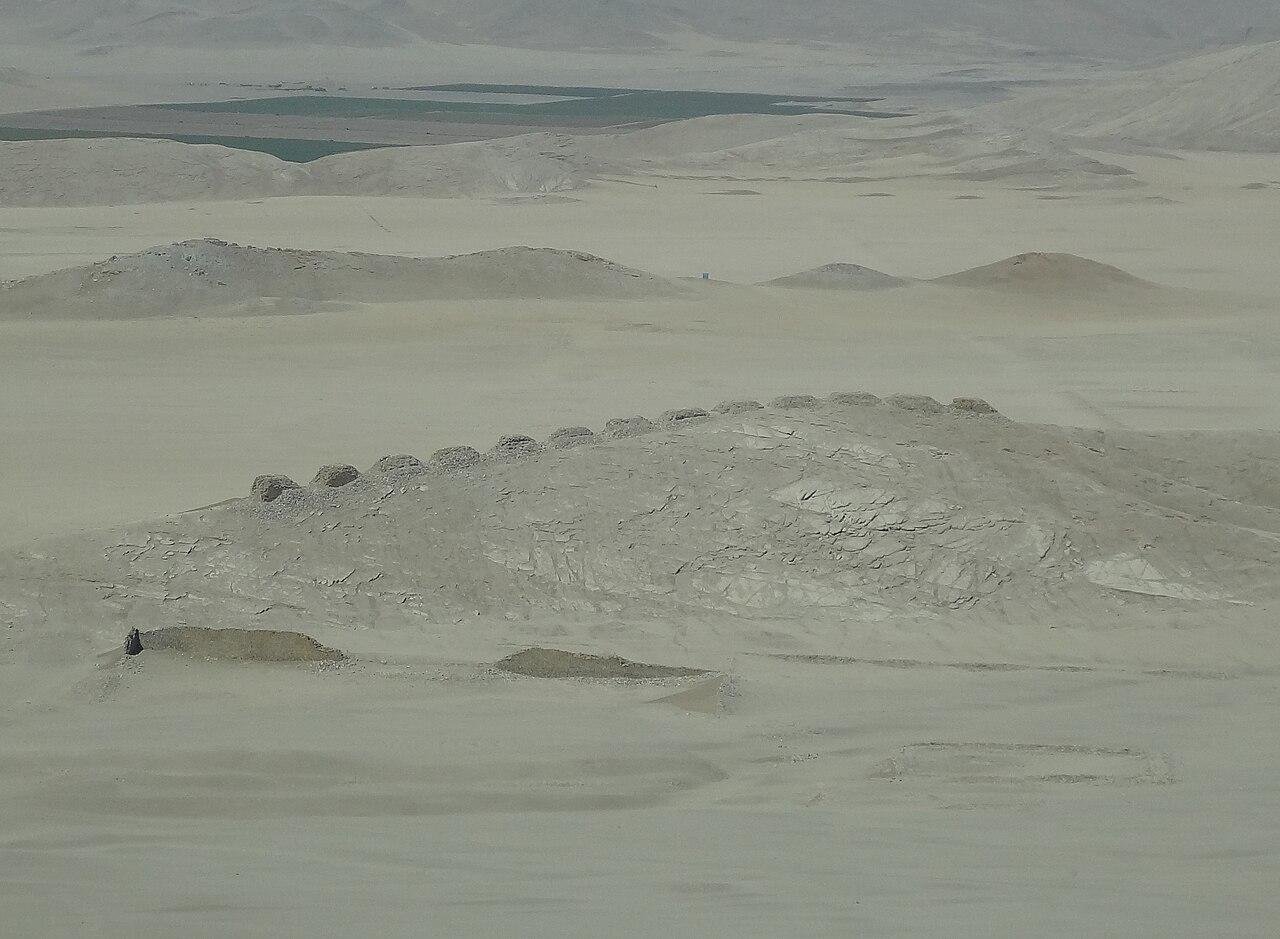
Researchers at the Chankillo Archaeoastronomical Complex in Peru have discovered an ancient structure that existed before what was considered to be the oldest known observatory in the Americas: the Chankillo Solar Observatory. According to an announcement by the Peruvian Ministry of Culture, this discovery is rewriting current timelines for when astronomy first took root in the Andes.
Astronomical Observatory of Chanquillo in the San Rafael Valley, Casma Province, Ancash, Peru. Credit:Juancupi/CC BY-SA 4.0
The newly discovered structure is situated in the desert landscape of the Casma River valley in the Ancash region, a particularly renowned area for its exceptionally early ceremonial and architectural traditions related to the Casma-Sechín culture. According to the archaeologists, the building has a clear solar orientation and thus appears to have been deliberately constructed for tracking celestial events. Given the construction materials used, stratigraphy, and architectural features, it is considered to be considerably older than the observatory built around 250 BCE and later included in the UNESCO World Heritage List.
Although radiocarbon dating is still in progress, this evidence suggests that organized astronomical planning emerged in this region far earlier than previously documented. The researchers say that this could also make the structure one of the earliest known examples of solar-focused architecture in the Americas and extend the roots of Andean sky-watching traditions by centuries.
Excavations also revealed a corridor aligned with the lunar cycle, an element that adds a new dimension to the site’s significance. The careful orientation suggests that ancient sky watchers at Chankillo were monitoring not only the annual movement of the sun across the horizon but also the far more complex rhythms of the moon. This dual system of sky observation suggests a sophisticated understanding of celestial patterns, and a scientific tradition deeper and more diverse than earlier archaeological records suggested.
Apart from the astronomically related discoveries, the scientists found a large ceremonial vessel of the Patazca style, about a meter tall, with clay figures of warriors in dynamic combat poses. It was found in an area of restricted access near the observatory, which might indicate that elite groups combined ritual authority, military leadership, and astronomical expertise. Its placement reinforces the idea that sky observation at Chankillo was closely linked to political power and ceremonial life.
The Ministry of Culture of Peru emphasized that this set of findings consolidates Casma’s position as one of the most important ancient centers of astronomy in the world. Restoration and conservation works continue with the purpose of preparing the Thirteen Towers, the observatory, and the surrounding structures for future public access.
For generations, the limestone rock shelters of southwest Texas and northern Mexico have hidden some of the most spectacular ancient artworks in North America. These vivid Pecos River style murals—towering human-like figures, animals in motion, and intricate abstract motifs—have been the source of wonder for archaeologists for many decades. Only recently, however, has an innovative scientific approach to dating the ancient paint itself made it possible to determine the actual age and duration of this artistic tradition.
Rock art along the U.S.–Mexico border, now dated to nearly 6,000 years ago, endured as a unified artistic tradition for more than 4,000 years. Credit: K. L. Steelman et al., Science Advances (2025);CC BY-NC 4.0
Using two combined radiocarbon methods, the researchers examined a total of 12 mural sites across the Lower Pecos Canyonlands. The team applied plasma oxidation to extract small traces of organic carbon from the paint layers, material likely left by binders such as plant matter or animal fat. Those samples were then analyzed throughAccelerator Mass Spectrometry, producing 57 direct radiocarbon dates in addition to 25 indirect dates from mineral accretions that formed over the paintings. This allowed the scientists to build a detailed chronology through Bayesian modeling.
The results indicate that the Pecos River style tradition originated nearly 6,000 years ago, most likely between 5760 and 5385 years ago. It continued until around 1,400 to 1,000 years ago, making the practice’s duration close to 4,000 years, or about 175 generations. Few artistic traditions anywhere in the world show this much longevity and continuity.
Even more remarkable is the consistency of the imagery across such a long timescale. The analysis demonstrated that the majority of the murals did not result from gradual accumulation but were, in fact, created as unified compositions. Artists followed recurring patterns in the placement of figures, the stratification of colors, and the framing of scenes. Red and yellow mineral pigments, often derived from iron oxides, were used according to a sequence passed down through generations, implying a deeply rooted visual language.
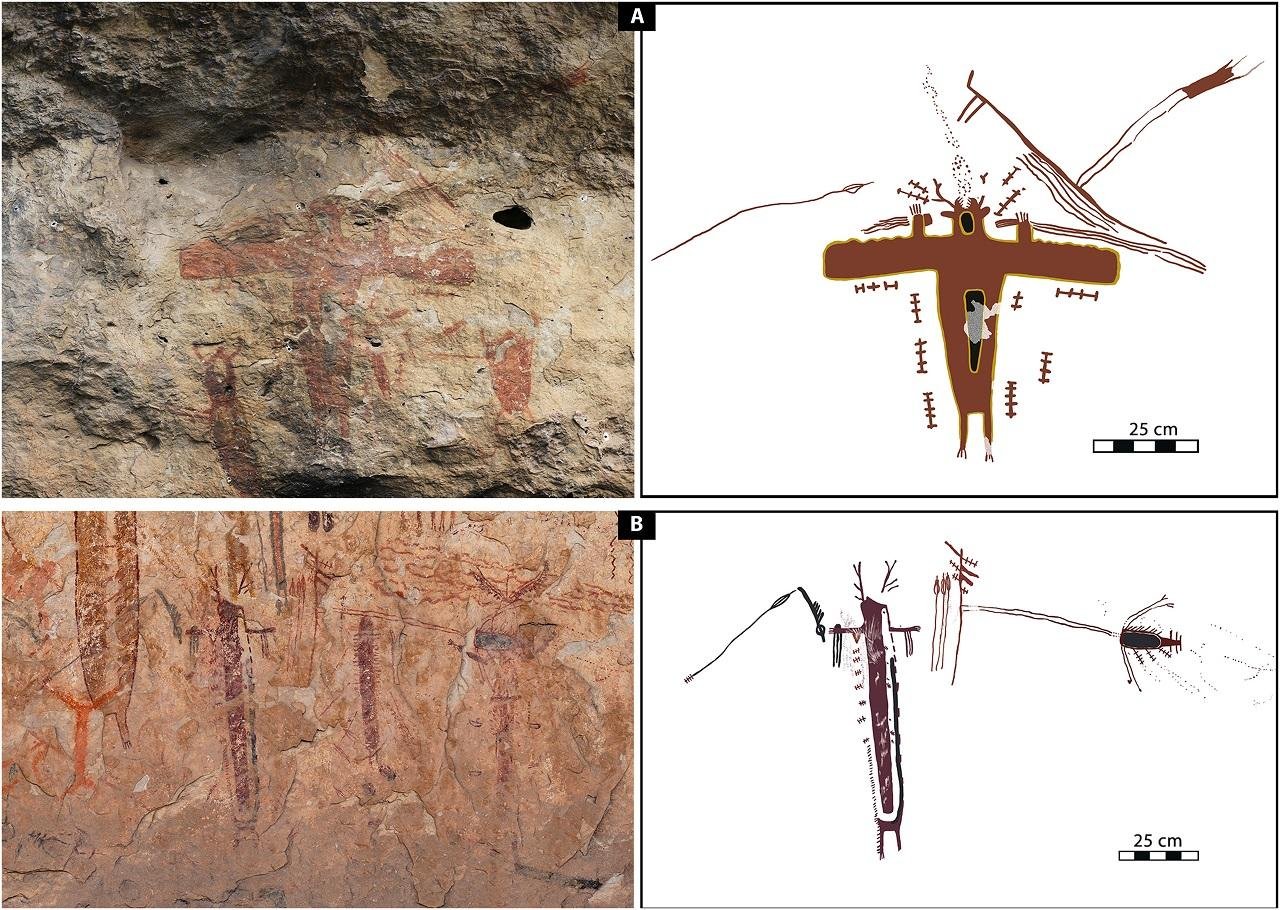
Power-bundle motif at 41VV286 and 41VV1230. (A) At 41VV286, a winged anthropomorph (A4) with a power bundle was radiocarbon dated as 2960 ± 100 RCYBP (CAMS ID 191217, sample no. 1, 3370 to 2860 cal B.P., 95.4% probability, table S1). The chronological model estimates painting at 41VV286 to 2995 to 2800 cal B.P. (68.3% probability). (B) At 41VV1230, an anthropomorph with red antler tines tipped with black dots (A5) was radiocarbon dated as 2050 ± 45 RCYBP (CAMS ID 190057, sample no. 4, 2125 to 1870 cal B.P., 95.4% probability, table S1). The chronological model estimates painting at 41VV1230 to 1990 to 1925 cal B.P. (68.3% probability). This is one of the youngest dated power bundles in the study. ILLUSTRATION CREDIT: C.E.B. Credit: K. L. Steelman et al., Science Advances (2025);CC BY-NC 4.0
The narratives of these murals seem to be based on a sophisticated worldview. Recurring motifs and ordered compositions are indicative of a shared “cosmovision”—a concept that describes the way one perceives the universe, creation, and time cycles. Such ideas were kept stable during periods of changing climate, technology, and subsistence among surrounding hunter-gatherer societies. The murals’ persistence indicates that this belief system played a key role in shaping community identity and ritual practices.
Elements of such ancient metaphysical beliefs later appeared in the symbolic traditions of Mesoamerican agricultural societies, including the Aztec and Maya, and in the beliefs of some modern Indigenous communities. The new study not only sheds light on a vast artistic legacy but also provides a dating method that may help unlock the chronology of rock art traditions around the world.
The patolli consists of tiny tesserae—sherds of red and orange pottery—set in a rectangular layout crossed by a central axis. Credit: Julien Hiquet, Naachtun Petén Norte Archaeological Project
Archaeologists working at Naachtun, a Maya city between Tikal and Calakmul, have uncovered a unique fifth-century patolli board. Patolli or patole is one of the oldest known games in America. It was a game of strategy and luck played by commoners and nobles alike.
Unlike other boards that were simply scratched or painted onto plaster, this one was built directly into the floor—a mosaic of hundreds of ceramic fragments set into fresh mortar.
“This way of creating the board may provide a fresh perspective on the way the game was played,” wrote archaeologists Julien Hiquet and Rémi Méreuze of the French CNRS inLatin American Antiquity. “It indicates boards could be included in the architecture from the planning stage and also potentially have a long use life.”
Set in Stone
Patolli game board schematic. Credit: Wikimedia Commons.
In the residential compound known as Group 6L13, Hiquet and Méreuze’s team excavated Structure 6L-19, a building once part of a grand household. Beneath a later wall, embedded in a floor now mottled by centuries of decay, they found the board: 478 tesserae, each no larger than a coin, laid in a rectangular grid crossed by a central axis.
Digitized reconstructions show a game space of roughly 80 by 110 centimeters—large enough for two opponents to sit face to face. Archaeologists recovered many of the fragments from household pottery, and their red and orange hues still show faintly.
“The creators had to gather hundreds of sherds of similar size and color and then inlay them into plaster,” the archaeologists wrote. “This is much costlier than the common modes of creation”.
Floor mosaics are almost unheard of in ancient Maya architecture. The technique is laborious, requiring builders to align and press each fragment before the mortar hardens. Yet the artisans of Naachtun executed it with deliberate care. The board’s sides align with the cardinal directions—its red tones evoking the East, the color of sunrise and renewal in Maya cosmology.
People across Maya society enjoyed patolli and took part in the game. The aim was simple: move your pieces around the board and finish before your opponent.
The rules of patolli are known mainly from later Mesoamerican sources—particularly Aztec descriptions—but they give a good sense of how Maya players likely played the game.
Two opponents faced each other over a cross-shaped board divided into squares. Each player started with six markers, often made from small stones, seeds, or beans. To move, players cast five black beans drilled with a hole on one side. The number of holes that landed face-up determined how many spaces a piece advanced—essentially functioning like dice.
The goal was to move all your markers around the entire track and reach the end before your opponent did. Players could knock each other’s pieces back to the start by landing on the same square, adding a strategic edge. Gambling often accompanied the game; people bet personal items, food, or ornaments on the outcome.
More Than a Game
View of the patolli board in Structure 6L-19. Credit: Julien Hiquet, Naachtun Petén Norte Archaeological Project
Naachtun was no minor outpost. From about A.D. 250 to 900, it was a major regional capital, a political buffer between the rival powers of Tikal and Calakmul. Excavations show the city’s elites lived amid vaulted architecture, imported obsidian, and fine ceramics. One of these households probably owned Structure 6L-19, the place where archaeologists found the board.
Peru’s 3000 Year Old Elongated Heads Suddenly Show Features Not Seen Before
History books tell us the Americas were totally cut off from the rest of the world until Columbus showed up, but a graveyard in Peru just smashed that timeline into a million pieces. Archaeologists digging in the desert found three hundred skulls that break every known law of human biology. They are too heavy, too big, and missing the bone plates that every human on Earth is born with. But the shape isn’t even the scary part. The DNA results just came back from the lab, and they reveal a genetic bloodline that has absolutely no business being in South America 3,000 years ago. This isn't just a new discovery; it is a rewrite of the human species.
The Black Sea May Be an Ancient Quarry, Researchers Debate
Dive into two of the strangest water mysteries on Earth. First, we explore the Black Sea - a place with layered waters that never mix, perfectly preserved ancient shipwrecks, underwater “rivers,” lost settlements, and theories about ancient tunnels and even a possible man-made past. Then we move to Lake Michigan, where scientists recently discovered mysterious holes on the lakebed, patterns no one can fully explain yet. Both places raise the same question: what else is hiding underwater that we still haven’t uncovered?