Ranking Roman coins: $0 to $100,000,000!
Videos
https://www.youtube.com/shorts/Asdz3vxfa6M?feature=share
https://www.youtube.com/shorts/yKCDzoTen2o?feature=share

Videos
https://www.youtube.com/shorts/Asdz3vxfa6M?feature=share
https://www.youtube.com/shorts/yKCDzoTen2o?feature=share
Chronological overview of the first known gemstones based on archaeological evidence, progressing up to the introduction of the four traditional precious gems around the Bronze Age.

Approximate Date Gemstone Name Key Details and First Known Use
c. 75,000–40,000 BCE Ochre & Shells (proto-gemstones) Earliest symbolic use in South Africa (Blombos Cave) and Spain (Cueva de los Aviones); red ochre for body paint and perforated shells/amber-like resins as beads for adornment or rituals. Not true minerals but foundational to gem culture.
c. 40,000 BCE Amber Paleolithic Europe (Baltic region); fossilized resin pierced for necklaces, valued for warmth and "magical" static electricity; earliest organic "gem."
c. 10,000–6500 BCE Jade (Nephrite) Neolithic China; carved into ritual tools and ornaments, symbolizing purity and heaven; one of the first systematically mined stones.
c. 6500 BCE Lapis Lazuli Neolithic Afghanistan (Badakhshan mines); traded to Mesopotamia for beads and pigments, representing the divine sky; oldest mined gemstone.
c. 5000 BCE Turquoise Sinai Peninsula/Egypt; used in amulets for protection and rebirth; sky-blue hue tied to afterlife beliefs.
c. 4500–4000 BCE Carnelian Sumer (Mesopotamia)/Indus Valley; etched beads traded widely, symbolizing blood and vitality; first long-distance gem trade.
c. 4000 BCE Amethyst Ancient Egypt; jewelry and scarabs; purple quartz believed to prevent intoxication (Greek lore later amplified this).
c. 4000–3000 BCE Garnet Egypt/Sumer; red beads in tombs for safe passage; almandine variety most common early on.
c. 2000–1600 BCE Peridot Egypt (Red Sea mines, known as "topaz" in antiquity); Cleopatra's favorites; green olivine for talismans.
c. 1600 BCE Sapphire, Ruby, Emerald Classical Greece imports via Silk Road from India/Sri Lanka (sapphire/ruby as corundum) and Egypt/Colombia (emerald as beryl); first classified as "precious" by Greeks alongside diamond; used in zodiac jewelry and lore for healing.
c. 800–300 BCE Diamond Ancient India (Golconda mines); earliest mining for colorless carbon crystals; initially for drills, later as gems symbolizing purity in Vedic texts.
| 1957 |
(Zoom in by clicking images)

Treasure Map of the United States (1957)

Treasure Map of North America (1959)

Wild Bill Hickok Treasure Map (1952)


Caribbean Islands to Madagascar Island
Gemstone capitals of the world

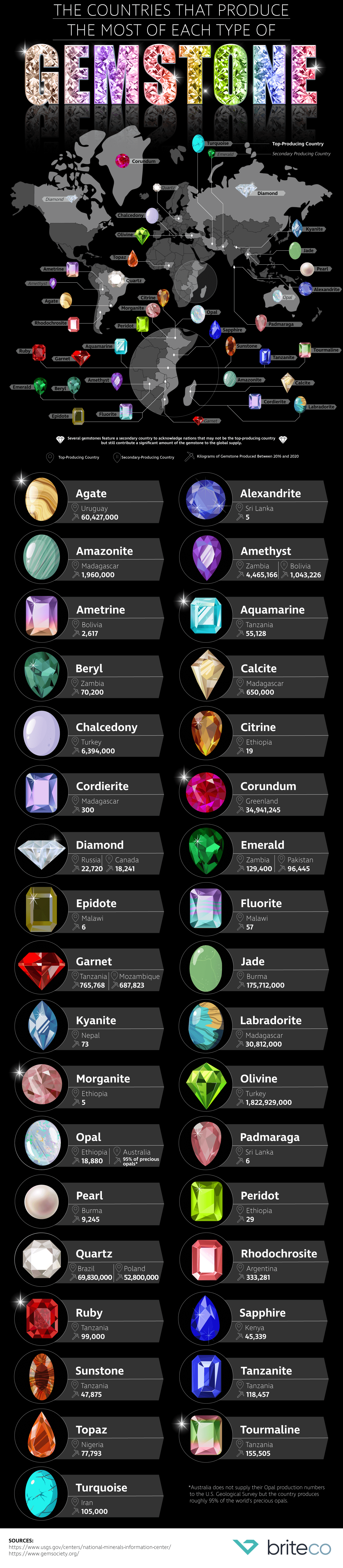
Gemstones are found in countries all around the globe, although some parts of the world are much more abundant in these precious stones than others. So which countries have become the biggest sources of gemstones and diamonds? To answer this, the team at BriteCo created a world map that highlights the top-producing country for more than 30 different gemstones.
The map was created using data from the United States Geological Survey (USGS)’s Mineral Yearbook 2020, which tracks the amounts of different types of gemstones, diamonds, and other minerals that countries around the world produce each year. The team looked at countries’ production of each type of gemstone in kilograms from 2016 to 2020 to determine each material’s top producer.
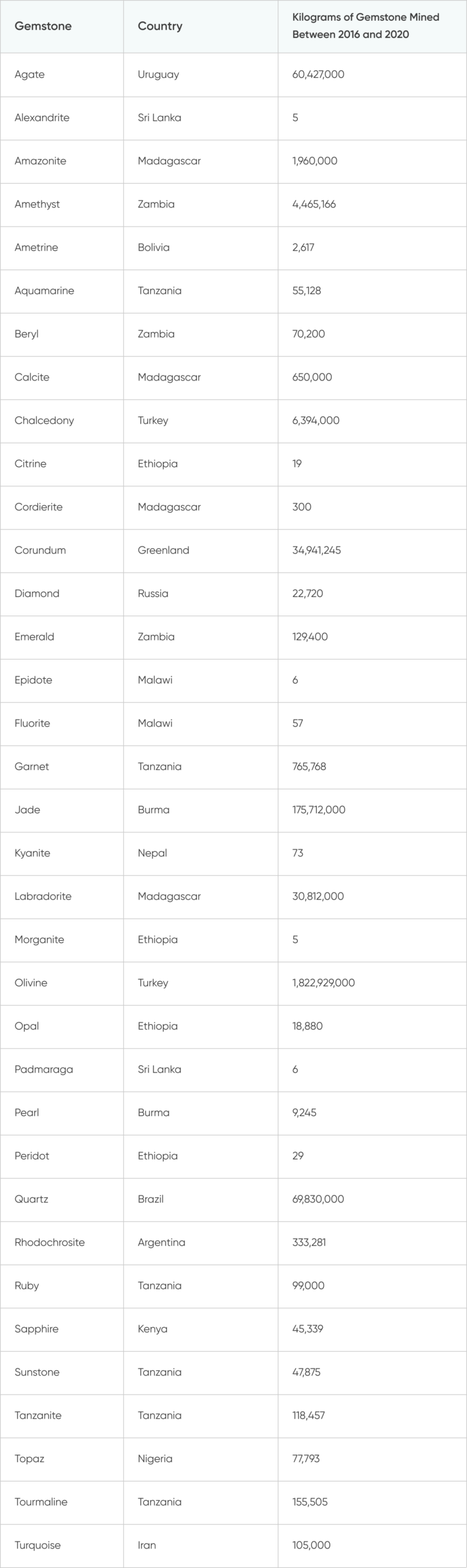
Several gemstones also include a secondary country on the map to acknowledge nations that may not be the top-producing country but still contribute a significant amount of the gemstone to the global supply. Explore the world map and gemstones chart below to see which countries are the biggest producers of 35 of the most dazzling and sought-after gemstones on the market.
66w,
224w,
44w,
768w,
336w" data-lazy-sizes="(max-width: 1500px) 100vw, 1500px" data-lazy-src="https://brite.co/wp-content/uploads/2023/08/countries-produce-most-each-gemstone-7-1.png" data-ll-status="loaded" />
Which Country Produces the Most Diamonds?
The country that produces the most diamonds is Russia, with 113,600 thousand carats produced between 2016 and 2020. This large amount translates to 22,720 kilograms worth of diamonds, for a more direct comparison to the other many other gemstones on the list.
Russia produces 31% of the global supply of diamonds, most of which is supplied by diamond mining company Alrosa. Canada produces the second-most diamond gemstones in the global supply, with 91,260 thousand carats mined during this time. Other large diamond producers around the world include Botswana, Angola, and South Africa.
The 5 Countries That Produced the Most Diamonds (2016-2020)
- Russia: 113,600 thousand carats
- Canada: 91,206 thousand carats
- Botswana: 76,400 thousand carats
- Angola: 39,370 thousand carats
- South Africa: 17,420 thousand carats
Which Country Produces the Most Emeralds?
According to the USGS data, Zambia produces the most emeralds in the world. Between 2016 and 2020, the country produced 129,400 kilograms of emerald gemstones. Emeralds from Zambia have grown in popularity due to their level of clarity, the depth of their color, and their tendency to be stronger than other countries’ emeralds.
Zambia is also known to produce the largest emeralds, with some weighing in at more than a kilogram each! Just one mine in Zambia, the Kagem Mine, is the single largest producer of emeralds in the world, accounting for 25% of the entire global supply of emeralds.
Which Country Is the Top Producer of the Most Gemstones?
Tanzania is the top-producing country for the most gemstones, with the highest production rate for six on our list of gemstones. The six gemstones Tanzania was found to produce the most of are aquamarine, garnet, ruby, sunstone, tanzanite, and tourmaline. Tanzania’s most plentiful gemstone is garnet, with the country producing 765,768 kilograms of the dazzling red gemstone between 2016 and 2020.
What Is Tanzanite?
This blue and purple gemstone was discovered in Tanzania, which led the jewelry company Tiffany & Co. to give it the name Tanzanite in the 1960s to capitalize on the gemstone’s rarity and the fact that it can only be found in one location in the world. The gemstone’s scientific name is blue zoisite, and it is one of the official birthstones of December.
The following countries were found to be the top-producing country for multiple gemstones:
- Tanzania is the top-producing country of six gemstones: aquamarine, garnet, ruby, sunstone, tanzanite, and tourmaline.
- Ethiopia is the top-producing country of four gemstones: citrine, morganite, opal, and peridot.
- Madagascar is the top-producing country of four gemstones: amazonite, calcite, cordierite, and labradorite.
- Zambia is the top-producing country of three gemstones: amethyst, beryl, and emerald.
- Burma is the top-producing country of two gemstones: jade and pearl.
- Malawi is the top-producing country of two gemstones: epidote and fluorite.
- Sri Lanka is the top-producing country of two gemstones: alexandrite and padmaraga.
- Turkey is the top-producing country of two gemstones: chalcedony and olivine.
Losing an expensive piece of jewelry with a precious gemstone or a dazzling diamond in it is never easy, but having jewelry insurance in place will allow you to breathe a sigh of relief if it ever does happen.
BriteCo jewelry insurance covers theft, damage, and loss with a limited impact on your homeowners policy. And if the value of your jewelry item increases over time, we’ve got you covered with a replacement of up to 125% of the jewelry’s original value when your policy began.
Top Gemstone Producers
89w,
305w,
768w,
457w" data-lazy-sizes="(max-width: 762px) 100vw, 762px" data-lazy-src="https://brite.co/wp-content/uploads/2023/08/Top-Gemstone-Producers-_1_-scaled.webp" data-ll-status="loaded" />
If posted pictures from the article above are blurry or distorted, then please click Article below.
Article
The Countries That Produce the Most of Each Type of Gemstone - BriteCo
Roman Greek and other ancient coins
What is numismatics? The study of coins, paper currency and medals. Fun fact: the University of Calgary has the largest collection of coins (more than 23,000) in Canada.
Video
https://www.youtube.com/shorts/gg1a811wJSU?feature=share