I mentioned in the video that platinum stays cool further away from the flame and withstands brutal temperatures up to 1,768°C. Because of this, the fine jewelry trade actually has to compete with aerospace and automotive engineering for this metal.
In the early 20th century, engineers realized that platinum's extreme melting point and low thermal expansion made it the ultimate material for high-performance spark plug electrodes. In an engine combustion chamber experiencing thousands of violent explosions per minute, a standard copper or steel electrode would quickly erode, melt, or warp from the thermal shock.
Platinum electrodes, however, could sit directly inside an engine's inferno for tens of thousands of miles without degrading. When you wear a platinum ring, you are wearing the exact same material engineered to survive inside jet engines and industrial chemical furnaces.
In 1879, amateur archaeologist Marcelino Sanz de Sautuola uncovered mysterious paintings inside Altamira Cave in Spain. His conclusion shocked the scientific world—and for years, almost no one believed him. Decades later, new discoveries proved he had been right all along. One discovery. One controversy. A story that changed archaeology forever.
They Thought Teotihuacan Had No Secrets Left... Then the Ground Collapsed
Archaeologists believed Teotihuacan had revealed nearly all of its secrets. But in 2003, a sudden sinkhole uncovered a hidden underground tunnel that had been deliberately sealed for nearly 1,800 years. What they discovered inside transformed our understanding of one of the greatest ancient cities in the Americas—while leaving its biggest mystery unsolved.
In 1519, Spanish explorers entered the Valley of Mexico expecting unfamiliar lands. Instead, they encountered Tenochtitlan—one of the largest cities in the world at the time. Built across islands in Lake Texcoco and connected by causeways and canals, it showcased remarkable engineering and urban planning centuries before modern technology. Archaeological discoveries continue to support many of the historical descriptions recorded by early eyewitnesses.
An AI engineer working outside academia says he has decipheredLinear A, a Bronze Age writing system from Crete. Tom Di Mino made the claim in June, and his research is now being examined by linguistics scholars at Rutgers University and the University of Cambridge. Linear A has not been read by professional linguists in more than 100 years, despite decades of study.
Di Mino says the discovery centers on a prayer text repeated at five sanctuary sites on Crete. Most of the words in the prayer were already understood, but one verb had no known meaning.
Di Mino traced that verb to a root shared with Hebrew and Akkadian, tied to the idea of living in or settling a place. Once translated, he says the passage reads much like a later Hebrew prayer, but directed at a goddess rather than a god.
A researcher named Cyrus Gordon proposed a similar Semitic link for Linear A in 1957, but few linguists accepted it. Di Mino says his work goes further by connecting specific inscriptions directly to the structure of Hebrew prayer.
How an AI engineer put the Linear A theory to the test
To test his theory, Di Mino, an AI engineer, wrote a set of Python scripts using a coding tool called Claude Code. The scripts checked his proposed word against two digital collections of Linear A writing, known as GORILA and SigLA, covering nearly every surviving inscription.
300w, 1024w, 768w, 80w, 160w, 150w, 600w, 696w, 1392w" data-lazy-sizes="(max-width: 1280px) 100vw, 1280px" data-lazy-src="https://greekreporter.com/wp-content/uploads/2026/07/linear-a-inscription-at-the-museum-of-prehistory-in-thera-credit-olaf-tausch-wikimedia-commons-cc-by-30.jpg" data-ll-status="loaded" />Linear A inscription at the Museum of Prehistory, in Thera. Credit: Olaf Tausch / Wikimedia Commons / CC BY 3.0
He says the results include proposed sounds for 40 previously unclear signs, a list of 408 translated Linear A words, and a nine-page draft describing the grammar of the prayer text.
Linear A was used from about 1800 BC until 1450 BC, whenMycenaean Greekstook control of Crete and adapted the script into a related writing system called Linear B. Linear B was read in 1952 and identified as an early form of Greek.
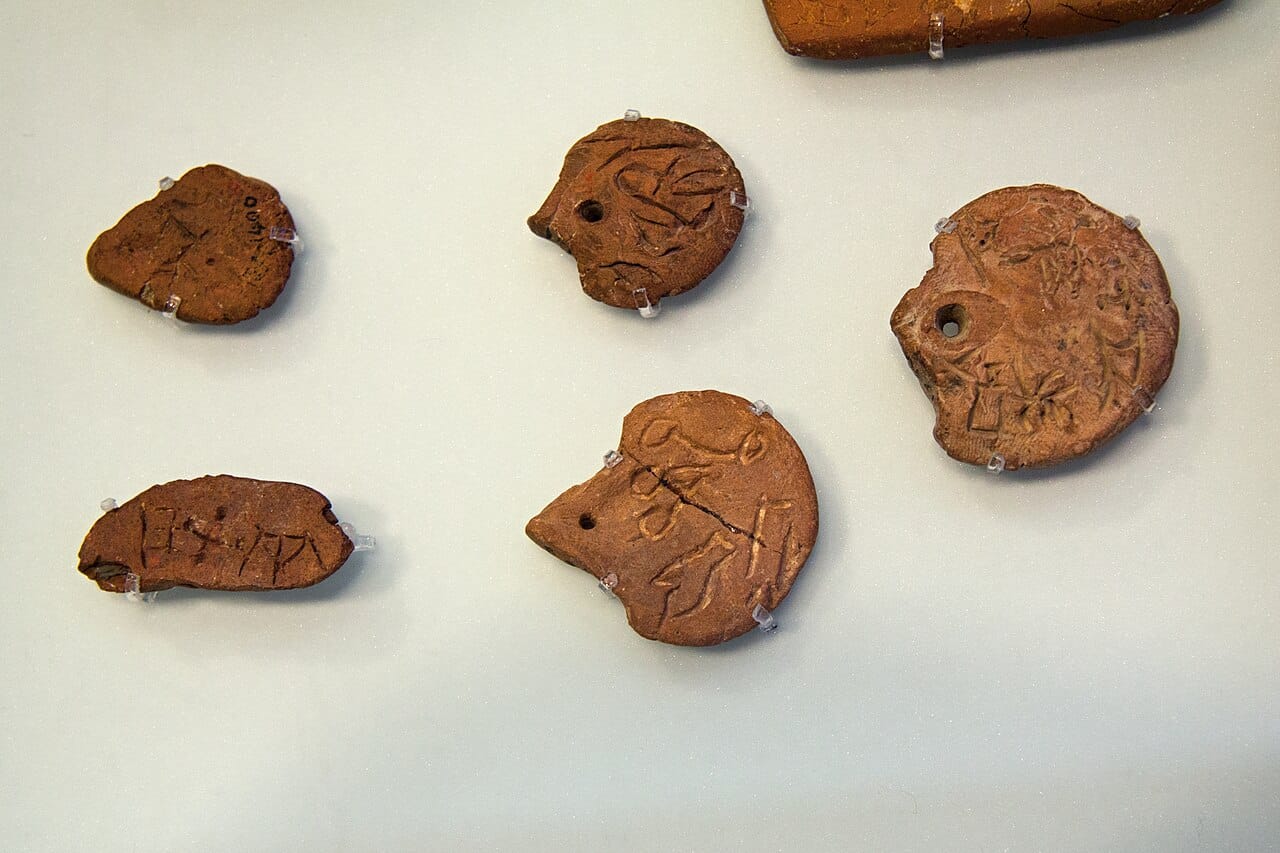
Pendants with Linear A inscriptions from Crete. Credit: Zde / Wikimedia Commons / CC BY-SA 4.0
Linear A has remained unread partly because it has never been tied with confidence to any other known language. Its full record amounts to about 7,500 characters, a small sample that leaves room for competing readings.
Linguists say Di Mino’s claim will need to pass peer review before it can be treated as a confirmed decipherment.
Self-taught AI engineer behind the Linear A decoding
Di Mino has no formal training in linguistics. He lives in New York’s Hudson Valley and has taught himself classical history andancient languagessince he was 18, gaining some ability in eight of them, including Attic Greek, Latin, Sanskrit, Arabic and Ugaritic.
He first became interested in Linear A seven years ago and has traveled to Crete twice. His concentrated work on the script began in January, and he says the breakthrough came on May 22.



 300w,
300w, 


 300w,
300w, 


