Tags
Tab Item Content
Join Us!
Archives Meta
Archaeology by Prau...
 
Notifications
Clear all

Archaeology [Sticky] Archaeology by Prau123

2,361 Posts
12 Users
27 Reactions
6 M Views
Prau123 avatar
Posts: 3856
Topic starter
(@prau123)
Famed Member
Joined: 7 years ago


"Green Treasures from the Magic Mountains" by Alison Sheridan


Video


The Magic Mountains mentioned in the video is referring to Italian Alps where jade was mined 6,000 plus years ago. The indigenous people mined and carved the jade gemstone into sacred ceremonial axes. Eventually hundreds of them were being distributed and traded throughout Europe.


Reply
Prau123 avatar
Posts: 3856
Topic starter
(@prau123)
Famed Member
Joined: 7 years ago


💎 Museo del Jade en Chiapas 📽️


Video


https://www.youtube.com/shorts/ZwSBVBKf_uc?feature=share


Reply
Prau123 avatar
Posts: 3856
Topic starter
(@prau123)
Famed Member
Joined: 7 years ago


The ring that could destroy a city.


Signet rings were used to secure highly sensitive military and legal documents. But the ring was only half of the security system. The other half was the chemistry of the wax itself.

The "wax" they used wasn't the soft, oily candle wax you find in your house today. Candle wax is pretty useless for security because you can easily peel it open and melt it back together. True historical sealing wax was a resin rich thermoplastic compound. It was heavily formulated with pine rosin, shellac, and heavy earth pigments like vermilion.

When the hot liquid cooled, it didn't stay soft. It dried into an incredibly hard, brittle plastic. It was specifically engineered to act as a tamper evident seal. If a spy tried to carefully pry the letter open, the brittle wax would audibly snap and shatter into dozens of pieces, making it difficult to put back together without anyone noticing

Wax was only one part of the system. The stronger historical security system was often wax plus folding, slits, tucks, ribbons, thread, parchment tags, or letterlocking. The Royal Society describes letterlocking as using folds, tucks, slits, threads, and wax seals to tamper-proof letters and preserve privacy


Video


Reply
Prau123 avatar
Posts: 3856
Topic starter
(@prau123)
Famed Member
Joined: 7 years ago


This video explores one of the most mysterious legends from the Inca Empire: the story of a sacred mirror said to have guided the ruler who transformed a small Andean kingdom into one of the greatest empires in history.

According to Inca traditions and Spanish chronicles, Pachacuti, the emperor who created the Inca Empire, possessed a remarkable mirror. Through it, he was said to see distant lands, understand the plans of his enemies, and receive guidance that shaped the future of his people.

The story begins before Pachacuti became emperor. As rival armies marched toward Cusco and the future of the Inca hung in the balance, a strange encounter at a sacred spring changed everything. Looking into a mysterious reflective object described as a crystal tablet, the young prince saw a supernatural figure that promised victory and a destiny far greater than he could imagine.

From that moment on, the mirror became a central part of Pachacuti's legend.

Historical accounts claim that he consulted the mirror throughout his life. It guided military campaigns, advised him on expansion, and helped inspire the creation of Tawantinsuyu, the vast Inca Empire that would eventually stretch across much of western South America.

But what was this mirror really?

Was it an obsidian mirror like those known from the archaeological record? Was it a sacred ritual object? A political symbol? Or simply a legend created to explain the rise of one of history's greatest empire builders?

This video explores the chronicles, archaeology, mythology, and historical evidence behind the mystery of Pachacuti's mirror and the extraordinary ruler who changed the course of Andean history.

If you're fascinated by ancient civilizations, lost knowledge, mysterious artifacts, and the hidden history of the Americas, this is a story you won't want to miss.


Video


Reply
Prau123 avatar
Posts: 3856
Topic starter
(@prau123)
Famed Member
Joined: 7 years ago


Archaeologists in Mexico have identified what may be the oldest known Maya Long Count calendar date in the lowlands, carved on a monument at El Palmar in Campeche. The date appears to correspond to August 31, AD 180, pushing the earliest known Long Count evidence in the region back by more than a century.
This discovery matters because Maya rulers used time itself as a source of legitimacy and power. By carving dates into stone, they were not just recording history, but also anchoring royal authority to the movement of the cosmos. 🗿


image


Article


Oldest Maya Long Count Date Found: How a Crumbling Stone Rewrites Maya History - Live Qurious


Oldest known Long Count inscription from the Maya lowlands found at El Palmar


A weathered stone monument from the ancient Maya city of El Palmar in Campeche, Mexico, has produced what researchers believe is the oldest known Long Count calendar date from the Maya lowlands. The inscription records the date 8.7.1.0.0, which corresponds to August 31, CE 180. The date is 112 years earlier than the previous oldest Long Count inscription known from the region.

Researchers examined three stone monuments, Stelae 20, 45, and 46, as part of a study on the rise of Maya kingship in the central lowlands. The Long Count calendar later became a key part of Maya political life. Rulers used it to record important events such as births, accessions to power, and ceremonial activities. Scholars have long known about its importance during the Classic period, which began around CE 250. Far less is known about how rulers first started using the system.

The work focused on monuments whose carvings had become difficult to read after centuries of erosion. El Palmar’s stelae are made from limestone, a material that gradually loses surface detail when exposed to the elements. Many inscriptions appeared too faint for traditional study.


Oldest known Long Count inscription from the Maya lowlands found at El Palmar
Stela 46. Left side, front face, and right side. Three-dimensional modeling by Kenichiro Tsukamoto, epigraphic drawing by Octavio Q. Esparza Olguín and Kenichiro Tsukamoto , and iconographic drawing by Daniel Salazar Lama © PAEP / Tsukamoto et al., Ancient Mesoamerica (2026); CC BY-NC 4.0

The team turned to digital technology to recover details hidden on the stone surfaces. They created three-dimensional models using photogrammetry and a high-resolution scanner capable of recording features as small as one-tenth of a millimeter. Digital lighting allowed researchers to view the carvings from many different angles. Marks that were nearly invisible on the original monuments became easier to identify on the computer-generated models.

Stela 46 produced the most important result. Researchers identified the Long Count date 8.7.1.0.0 and linked it to historical events recorded on the monument. Unlike several other early inscriptions from the Maya world, this monument does more than preserve a calendar date. The text appears to describe royal activities connected to that date.

Parts of the inscription point to the succession of a ruler. Other sections appear to describe ritual events. One reference may involve the Jaguar God of the Underworld, a figure associated with Maya religious traditions. The monument also contains references to the 260-day ritual calendar, suggesting that rulers connected political authority with sacred cycles of time.

The findings suggest that rulers in the central Maya lowlands were already using calendars as part of royal ceremonies during the Late Terminal Preclassic period. Public monuments served as records of these events and helped establish dynastic authority.

Evidence from El Palmar fits into a broader pattern seen across the region. The presence of carved monuments in several communities suggests that kingship was developing in multiple centers rather than in a single location. El Palmar provides one of the clearest examples from this early period because the monument combines calendar dates with references to royal actions.

Researchers note that some readings of the damaged inscriptions are still tentative. Future advances in imaging technology could clarify portions of the text that remain difficult to interpret. Even so, Stela 46 offers rare evidence from a time when Maya rulers were beginning to connect political leadership, ritual practice, and formal systems of recording time. Nearly 1,850 years later, traces of those events still survive on the surface of a worn stone monument.

More information: Tsukamoto, K., Esparza Olguín, O. Q., Salazar Lama, D., Campaña Valenzuela, L. E., Velázquez Morlet, A., & López Camacho, J. (2026). The emergence of kingship and early long counts in the Maya kingdom of El Palmar, Campeche, Mexico. Ancient Mesoamerica, 1–21. doi:10.1017/s0956536126100984


Article


Oldest known Long Count inscription from the Maya lowlands found at El Palmar | Archaeology News Online Magazine


Figure 1 - uploaded by Jessica Cerezo-Roman
 
image


Map of Yucatan Peninsula showing the location of El Palmar and other archaeological sites.


Article
 
Full-text available
 
Inspired by life course and osteobiography approaches, this article explores the life and death of an individual associated with the lakam title (“banner” in Colonial Yukatek Maya; thus, a “standard-bearer”), a nonroyal elite of Late Classic period Maya society (AD 600–850). Although these elites are depicted on polychrome vessels and carved monume...


Article


Map of Yucatan Peninsula showing the location of El Palmar and other... | Download Scientific Diagram


El Palmar (Maya site)

 
El Palmar
Wak Piit


Ceramic vessel with a palace scene from the royal court of El Palmar


Interactive map of El Palmar
 
Type Ancient Maya city
Periods Preclassic - Late Classic
Cultures Maya civilization
Location Mexico
Region Calakmul Biosphere Reserve
History
Built 300 BC - 880 AD
Built by Wak Piit dynasty
Abandoned 900 AD
Site notes
Area 94 km2 (36 sq mi)
Discovered 1936
Public access closed


El Palmar, originally called Wak Piit (Six Palanquins), is an archaeological site and ancient city of the pre-Columbian Maya civilization located within the Calakmul Biosphere Reserve in southeast Campeche, Mexico. It was a large Maya city with an occupation established since the late Preclassic period around 300 BC, it flourished during the early Classic period under the rule of a powerful dynasty that held several royal titles and had a royal court of high-level priests, officials, and scribes, which gave the city a great relevance in regional geopolitics. It reached its peak in the Late Classic period, during which the city developed an intense political activity, maintaining a vast network of alliances with distant sites, which made it one of the strongest political entities in southern Campeche.[1]

El Palmar is one of the largest archaeological sites in the region and extends over a vast area of 94 km², it consists of several archaeological complexes of monumental architecture with more than 10,000 identified structures, including plazas with large pyramidal bases, temples, palaces, 15 ball courts and numerous residential and ceremonial buildings. Each architectural complex had a specific function within the city, like ceremonial, agricultural or residential groups and also for lithic production. The main ceremonial center was designed to represent the sacred geography of Maya mythology, while other complexes functioned as high-ranking residences, such as the Guzmán Group, which was the residence of an important elite group from El Palmar known for having the title of Lakam (standard-bearers) who made diplomatic functions representing El Palmar throughout the Maya region, acting as emissaries in the political and military alliances of the city's rulers with other political entities.[2]

Some of the most important findings at El Palmar are a large number of high-quality monuments, including a large stairway with hieroglyphic inscriptions, altars, and more than 60 stelae such as Stela 46 from the Late Preclassic period, which contains the Mesoamerican Long Count date of 8.7.0.0.0, corresponding to September 5, 179 AD, the earliest Long Count date recorded by the Maya culture and also the earliest date recorded in the Maya Lowlands.[3]

The ancient Maya city of El Palmar was discovered and documented for the first time in 1936 by archaeologist Eric S. Thompson during an archaeological expedition in southern Campeche. Most of the archaeological site is buried beneath the thick jungle of the region within the ejido of Kiché las Pailas in the Calakmul municipality.

History

According to archaeological research, the occupation and initial settlement of El Palmar dates back to the late Preclassic period of the Maya civilization around 300 BC. The rulers of El Palmar used the title of Wak Piit which means "Six Palanquins" denoting their monarchical identity and high rank. The dynasty was active since ancient times in the transitional period between the late Preclassic period to the early Classic period of the Mayan civilization known as the Protoclassic period, according to the inscriptions, it had a sequence that lasted at least from the 2nd to the 9th century AD. The title of sak ho’ok was one of the royal titles used by the dynasty of El Palmar; it was worn by both the rulers and the royal court of the city, including master sculptors and scribes whose skills and knowledge were limited only to the elites. Since early dates the city and its dynasty showed its power to erect monuments such as El Palmar Stela 46 , which contains the long count date of 8.7.0.0.0 corresponding to September 5, 179 AD, making it the Maya stela with the earliest written date in the entire Maya Lowlands.[3]

The royal court of El Palmar included an important group known as the Lakam, or "standard-bearers" who performed various diplomatic functions, acting as ambassadors representing the city and carrying the emblem of their ruling house when traveling to other major cities in the region. The residence of the lakam was located in the architectural complex known as the Guzmán Group, a few kilometers from the city's center. One of the most important Lakam officials in the history of El Palmar was the ambassador Ajpach’ Waal, who had an extensive hieroglyphic stairway dedicated to him in a temple of the Guzmán Group, which records that on June 24, 726 AD, he arrived in Copán and met with its ruler Uaxaclajuun Ub'aah K'awiil to forge an alliance under the supervision of Yuknoom Took' K'awiil of Calakmul. A ceramic vessel from El Palmar named "El Señor del Petén" (The Lord of Peten) found at the Nuevo Veracruz complex of the Icaiché archaeological site in southern Quintana Roo, shows a palace scene in which the royal court of El Palmar, conformed by two priests with the title of aj’kuhu’n (worshipper), an heir to the throne referred to as a baahtz’am ch’ok, and another member of the elite who held the title of sak ho’ok, hold an audience with the ruler Aj Sak Bopat, who held several titles of royal authority such as Wak Piit Ajaw (lord of Wak Piit, the title of the rulers of the city), sak ho’ok, and baahkab (“First on Earth”), used to refer to high rank in the Maya nobility.[4]



Wikipedia


El Palmar (Maya site) - Wikipedia


New Hieroglyphic Stairway Discovered at El Palmar, Campeche


A new hieroglyphic stairway has been found at El Palmar, Campeche, Mexico, during investigations by archaeologists Kenichiro Tsukamoto (University of Arizona) and Javier Lopez-Camacho (INAH). It is Late Classic in date and its text looks to be long and interesting.

More details can be found at the National Geographic news article posted on April 25.

image


Article


New Hieroglyphic Stairway Discovered at El Palmar, Campeche – Maya Decipherment


Maya hieroglyphic stairway found in Mexico

 
image

A multi-disciplinary team of archaeologists excavating in the El Palmar Archaeological Zone in southeast Campeche, Mexico has uncovered a stairway engraved with Maya hieroglyphic inscriptions. Out of the thousands of known Maya archaeological sites, only 20 of them are hieroglyphic stairways and of those 20 few have survived undamaged by looters, time or nature. These stairs were found still in their original positions and engraved with over 130 Maya glyphs.

The staircase found on the El Palmar site is also unique because it was on the outskirts of the main center of the Maya city. The hieroglyphic stairways found before now have all been connected to the major monumental structures. That’s been part of the difficulty of finding original construction, because after the Classic Maya period (300 – 900 A.D.) there was a dramatic period of governmental and societal decline known as the “collapse” during which populations left the major centers and monumental construction ceased. When the cities were re-inhabited, people used the Classic structures for their stone and materials were recycled for reconstruction.


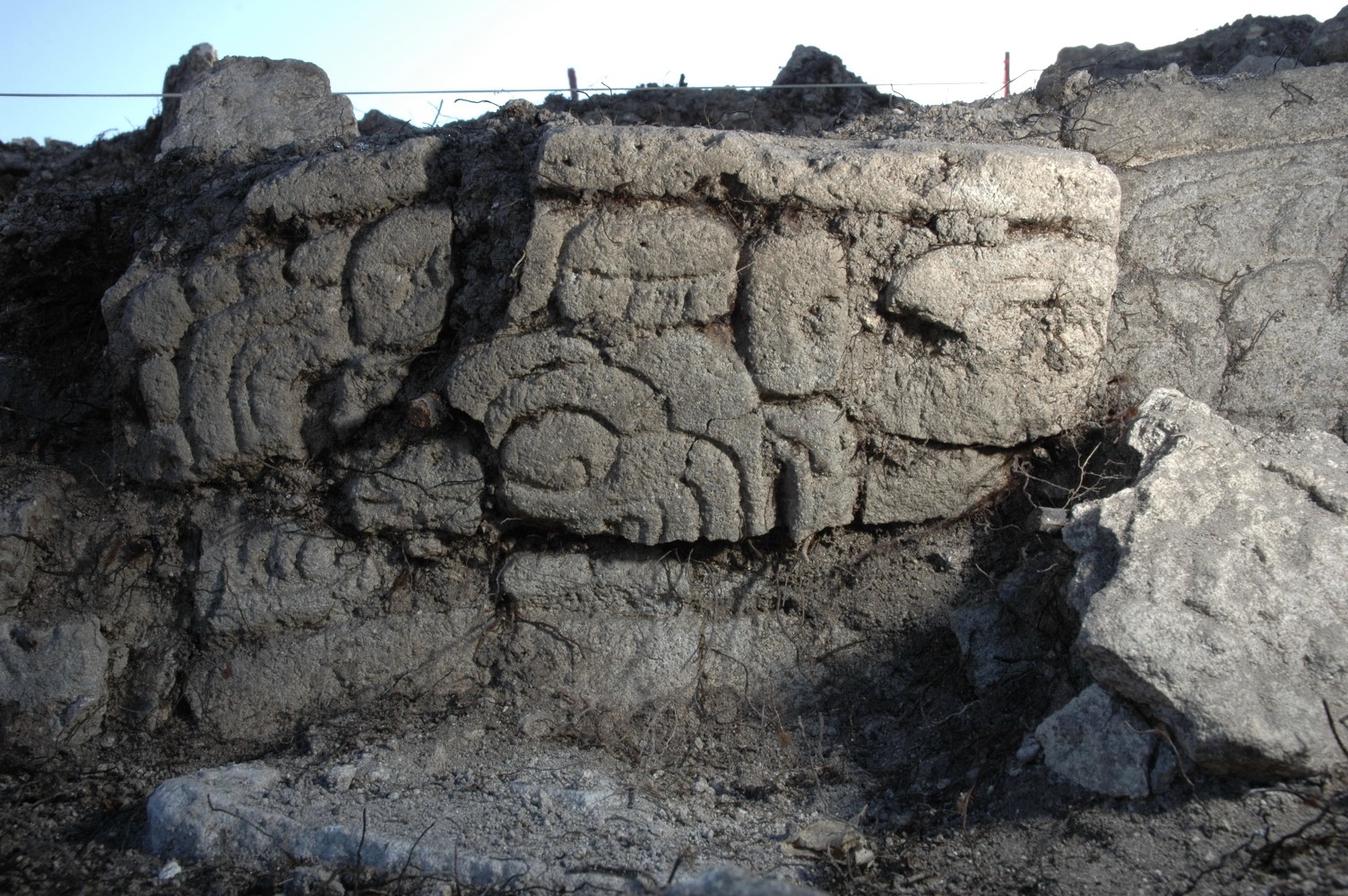
Detail of hieroglyphs on the Maya stairway


The El Palmar staircase wasn’t in the main city and it escaped recycling. That makes the inscriptions easier to read as well as providing information about the original construction of the building itself. It still needed a lot of help from the archaeological team, however.

The stairway was first discovered in 2009 when Gudiel Guzmán, a local worker attached to the fieldwork season of the joint team from the National Institute of Anthropology and History (INAH), the University of Arizona (UA) and the National Autonomous University of Mexico (UNAM), told Kenichiro Tsukamoto, a young archaeologist who was about to hit the big time while still a Ph.D. candidate at the University of Arizona, that he had found two carved stones while slashing and burning his property for agricultural purposes. Kenichiro and epigrapher Octavio Esparza went with Guzmán to see what he had found, and they realized that they weren’t just two stones, but part of a hieroglyphic stairway.

The stones were covered in dirt and had plants growing on them, but they were still close enough to the surface to make them a major looting target. The team changed their focus to salvaging and conserving the staircase, which they’ve been doing for the past two years. Now they’ve done enough work that they can announce their preliminary findings about the staircase and the inscriptions.


image


The pyramidal structure that holds the stairway was built between the 7th and 8th Centuries A.D. and a few decades after its construction a total of 90 blocks containing Maya glyphs were added, creating a stairway of six steps leading to a temple on top of the pyramid.

Octavio has partially deciphered the stairway inscriptions that commemorate an event dated probably to September 13, A.D. 726, and provide a list of successive El Palmar rulers. Of the most exciting finds was that the hieroglyphic stairway commemorated the visit of rulers from two major Classic Maya capitals: Calakmul and Copán. “Octavio’s decipherment suggests that Calakmul, Copán, and El Palmar were allies in the period just before Calakmul was defeated by Tikal [A.D. 736] and Copán by Quirigua” Kenichiro said in an interview.


image


They also found a variety of intriguing artifacts in the main temple, some broken vessels on a burned plaster floor, and the burial of an adult male with jade inlays on his front teeth (Maya grill!) containing two polychrome vases. Team anthropologist Jessica Cerezo-Román will conduct further analysis on the human remains.

There is much work left to do. The hieroglyphic blocks will all be restored and analyzed for dating, geologists will examine the original geographic source of the obsidians used in construction, and biologists will study the soil and sediment and the burned plaster floor. This discovery will have a great deal to tell us about the late Classic Maya period.


Sources


The Emergence of Kingship and Early Long Counts in the Maya Kingdom of El Palmar, Campeche, Mexico | Ancient Mesoamerica | Cambridge Core


I mentioned El Palmar in page 1 of this topic on April 22, 2020, but also in the previous forum named Eastbound in 2018.


El Palmar - El Palmar is 40 to 70 times larger than previously acknowledged.


https://www.discovermagazine.com/planet-earth/the-lost-world-of-the-maya-is-finally-emerging-from-the-jungle


It’s 40 times larger than we thought it was,” Garrison says. “This is now this huge city that would have been a rival to Tikal


https://www.technology.org/2018/09/28/lasers-reveal-a-vast-sophisticated-maya-civilization-under-the-guatemalan-jungle/


An early city called El Palmar seemed now to be 70 times larger than we had suspected, with raised fields for agriculture. An “isolated” royal palace had an extensive swath of settlement extending a kilometer or more.


Reply
Page 457 / 459
Share: